Thursday, May 29, 2008
White Water Kayaking in Ecuador
[pronounced Hatuun Yakuu]
I was blessed to be able to fulfill one of my dreams for this trip by going kayaking in Ecuador. Yesterday after church we took a bus from Quito to a little town called Tena. This 180km trip took a lightening fast 5 hours... LOTS of crazy switchbacks through the mountains and then jungles. It wasn't too bad a trip though, with only about 10 or 15 minutes where going over the edge seemed like a genuine possibility.
I was nervous and excited last night, and didn't sleep too good with kaykaing heavy on my mind. In the morning I got up and went to the Rios Ecuador shop to meet the raft trip I was supposed to kayak with. Upon arriving I discovered the raft group had cancelled, which meant for the same price ($59) I was going to get the trip anyway, but with a one-on-one guide! (this kind of thing normally costs $140 with Rios Ecuador). Sweet!
My guide Daniel was awesome: relaxed, professional, knowledagble. I couldn't ask for more. My rental gear which I was a bit nervous about really sucking, wasn´t too bad.
Boat: Dagger Redline - a bit older (late 90's?) but still a great 7 foot river runner. The outfitting was fairly old-school, but actually fit really well right with out much tweaking.
Helmet / PFD: Again a bit old school, but definetly meant for serious white water. My PFD was a nice Lotus Designs jacket - not the ghetto rafting PFDs I was a bit concerned I'd end up with.
Paddle: Crappy - a plastic Werner, which actually broke part way through the last serious rapid! I dropped into a fairly sizable hole to play around, and the paddle blade just bent away at the neck when I leaned into the low brace - no rocks or anything!
The River
The river has lots of names... Alto Napo, (Upper Napo) or Jatun Yaku (local name.) It means Big Water in Quechua, a dilect spoken by the indigenous people. The local name says it all! The river was a super fun run with big waves, wide lines and deep channels. Lots of catch-on-the-fly waves from 4-8 feet high, with hardly any really munchy holes to avoid. At different times it reminded me of the Ottawa Main Channel, Filo Bobos (Mexico), Lower Gualey (West Virginia), Pescados (Mexico) and Ruper (Quebec) rivers. There were moving flat sections after each big rapid and very few rocks. It's a perfect comercial run - safe, low consequence while still being fun and exciting. Since I hadn't been paddling in several months it was a perfect river to get back into kayaking with, a great big water class III.
Rio Jondachi and Rio Hollin
[pronounced Hondachii and Hoshin]
The night after paddling the Jatun Yaku with Daniel, I met a great guy named Tim who is actually one of the family members that pioneered the white water kayaking industry in Tena 15 years ago. At that time all Tena consisted of was a few dirt roads and thatched roofed huts. It turns out he that the next day he was running a river to test some radio gear with one of his senior guides (Victor.) The river would be a class III+/-IV and he invited me along for the cost of splitting gas - which I was super excited to take him up on!! So, I rented a Jackson Rocker (and a much better paddle than the first day) and was raring to go come morning.
The drive to the put in was gorgeous, and the hike down the canyon to the river was a steep, slippery 40 minute above-your-ankles-mud-stomp. The $3 employing one of the locals to carry our kayaks down qualifies as some of the best spent $$ of the entire trip!
It rained for most of the day, making the paddling more beautiful. There were all kinds of waterfalls coming down through the lush jungle vegetation on the canyon walls right into the river. In many ways the Rio Jondachi was like the Barrance Grande (Mexico) - a solid but not too crazy class III read-and-run boulder dodging river. The river was challenging enough to be interesting and low stress enough to be totally relaxing and enjoyable. The river's beauty is merely magnified by it's remote nature.
It is a minimum 2 hour hike from the few emergency exit points of the river to the nearest village, where there is usually cell phone reception. Then even farther before you get to the nearest road. River People - Tim's family's company - is the only company solid enough to run comercial trips here. From what I could tell, they are definetly the most pro company in Tena, with standards in many ways equivalent to Esprit.
When we met the Rio Hollin the river changed dramatically and became pretty solid big water. I didn't adjust quickly enough, and got pretty spanked through a couple big hydraulics in the first major rapid!! No swim, no harm done, just a pressure washing of my brain and some hoots and laughs from the guys! This clearly showed me I had to be more on my toes for this next section of river. It was a total blast. This section of the river was big water rapid after big water rapid - and definetly some holes you didn't want to go into! The best comparison I can make for Ottawa river folks is a river full of Normans & The Lorne with small flat sections in between rapids, with out the flat water paddling.
Kayaking in one of the most beautiful places on earth and spending time with a couple really cool, chilled out guys was an extreme blessing.This has definetly been one of my favourite days of our entire trip!!
Wednesday, May 28, 2008
When Art Matters
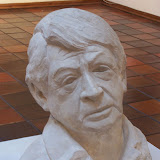
We spent a day visiting two sights that commemorate the work of a local artist. The first was "The Chapel of Man" a gallery Oswaldo Guayasamin had designed to house his paintings. His modern artwork focuses on the human body, mainly hands and faces to depicit the struggles and achievments of people over time. Mainly it is a tribute to Ecuadorians and South American but it also includes work that was inspired by visits to India, Nicaragua, Chile and Africa. The emotion that is evident in each piece is pognient and fierce. His work well thought out and expressive.
The second was a museum that housed the artists collection. When he passed away he donated his home and his collectionsto the people of Ecuador. There were three main sections: Pre- Columbian art (which consisted of pottery, jewellery and items used for rituals) Contemporary art (which was mostly religious and include over 40 different crucifixes) and a best of collection (containing portraits, murals and work that he had done.)
![]() |
| Oswaldo Guayasamin - La Capilla del Hombre |
Quito - One of South America´s Best Kept Secrets
Here are a few of the highlights of the city:
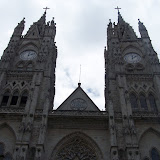
- The old city, as it is affectionately known by tourists, is the heart of the city. It is a labiryth of churches and convents. A local family who has travelled the world bragged that the Notre Dame Cathedral was disappointing compared to what they are used to back home.
- The Basillica has a few old and rickety bell towers, but that doesn´t mean you can´t climb them. Jay braved the poor infrastructure and got to the top anyway.
- We found an English speaking church. We were warmly welcomed in and a later we´ll be volunteering at the youth camp.
- Mariscal Sucre is the party district, sort of like the market downtown. Conviently that is where our hostel is located. There are all sorts of resturants, bar, stores, and travel agencies. They´ve figured out that tourists are a key clients in this area.
- An old Jesuit church is laiden with gold and symbolism that the guide tried to help us understand. When we visited they were celebrating the life of one of the local saints.
- We saw a local indigenous group protesting outside the Governor´s Palace.
- Once again we feel at home in the central park that is bustling with people, vendors, musicians and shoe shine boys. To top it off the park is well manicured and the fountains work.
Those are just a few of the fun things that we took in. We´ve enjoyed the people, the scenery and the weather. It´s worth taking a vacation to!
![]() |
| Visits to Old Quito Buildings |
Tuesday, May 27, 2008
Panama Canal - A Wonder of the Wolrd??
This is a look into a canal that geographically splits a country in two. It was built in the early 1900s with full operations starting in 1914. They used the top line technologies of their time, primitive to what we know today. And the best part is that some of the originals are still in use today, mainly the lock doors that open and close to change the water levels. Some of the parts of have been updated over time, such as the mechanisms that open and close the doors and the cable cars that guide the ships through.
Here are a few random facts about the ins and outs of the canal:
- The boats alot 24hrs to complete the journey across the oceans. Most of the time is spent waiting their turn. It takes 8 to 10 hours to go through the lock sets.
- The most expensive boat to go through was a cruise ship in 2007 who paid $330 000. The world record for least amount paid goes to a 140lb swimmer at a grand total of $0.37. In general the fee is determined by type of boat, length and weight.
- There are two reguirements for the boats to pass. The first is that the money must be bank transfered a minimum of 48 hours prior to crossing. The second is that the captain gives up the helm of his boat to a canal pilot who gives instructions while at the locks.
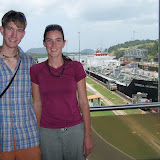
We arrived at the Miraflores Visitor´s Center at the perfect time. It was 9am and things were just in motion for a huge, full cargo ship. It was 4 hours later that we peeled ourselves away from the look out decks and went inside to walk the museum! While we watched the ships cruise their way throughs the locks a guide with a microphone was spouting out random facts about the canal. It was in English and Spanish. We learned alot and enjoyed the activity.
![]() |
| Panama Canal |
Sky Scrappers and Abandoned Buildings
* from a book called "The Country Under My Skin¨ by Gioconda Belli
Well there is nothing like entering into a large city after spending alot of time in smaller, rural places. Our first impressions were an intersting mix of being excited to see green space and wondering how the obviuos poverty and a worn down feel can co-exist with so much wealth. Panama City is the place where we have experienced the most contradictions and obvious contrasts between social classes. The history is complex, like most of Latin America. However what helps it stand apart is the canal and how that influenced the people and the country´s development.
The Old City
Our first stop was a large pedestrian only road lined with stores on both sides that stretched for quite some distance. You then had to brave one of the sketchy parts of town, it´s run down and people don´t have much at all as they stand in the decaying frame of a once elegant doorway. But a few blocks later there are beautifully restored churches and museums. Weaving your way through the streets you come upon an old pier that served as the look out port of the city back in the day. There are great walking paths with amazing views of the ocean, the boats and the city. When the tide is out there is rock in every direction.
The Causeway
A wonderful place to spend a warm, relaxing afternoon. A cheap 15 or 20min taxi ride of $1.50 gets you to group of 3 small islands that are connected by a palm tree lined road and walking path. The ocean can be seen all around, along with the sihilloettes of boats waiting for their turn thru the canal. It is picturesque, with locals walking or biking along the paths. By the time we arrived at the last island we were overwhelmed. Feeling like we´d landed in another world. One where there was abundant of wealth, evident by the yacht clubs and huge boats that were strangely mixed with abandoned resturants.
The Ruins
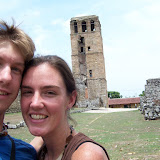
Remants of what used to be the original city stand along the ocean and a huge highway. Surrounded by parks and distance sky scrappers the 16th century buildings look a little out of place. The best preserved piece was the bell tower from the church. It all so served as a look out to get a great view of the city.
Aside from all the sight seeing we took time to enjoy our air-conditioned room that had cable TV. Ahh the luxuries!!!
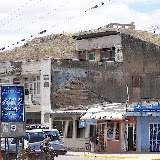
![]() |
| Panama City |
Wednesday, May 14, 2008
Sights and Sounds of Nicaragua
Language and Culture
- The Spanish spoken hear is the most difficult to understand yet. People say that if you can learn here you are set. It sounds like everyone has a mouth full of marbles. People rarely pronounce the "s" in words.
- Not everyone is nice. In general the people in Esteli weren`t friendly or polite.
- Some people here have blue eyes. It is amazing to see them with their dark skin and hair.
- There are few street signs so people give directions using landmarks.
- The street food was not appetizing though the traditional food was yummy.
- People live behind huge, complicated gates. They pull out rocking chairs out to their patio at night but sit behind them.
Entertainment
- If you are bored and looking for some evening entertainment there are casinos every few blocks. They seem to be into slots mostly.
- Shoes are a big thing here. You wouldn`t think that Payless Shoe Stores would be the shop of choice but it is!
- We attended our first English speaking church since we left home. Hallejuah!
- Don´t try this at home. We hypnotized a chicken. We had the most giggles while we tried to catch it.
Transportation
- Public transportation is a way of life for people in Nicaragua. You generally have 2 options: the chicken buses (old NA school buses with a new paint job and some gaudy decorations) or micro buses ( little VW vans). In either case if you are a gringo they try to steep up the price. We lost big time our first day going to the Nehemiah Center by paying 20 Cordobas. A local would pay 5 -7 Cords!
- Safety is on everyone´s minds, locals and tourists alike. A Nicaraguan worker from the Nehemiah Center was robbed and abandoned out on a country road by a taxi driver whose friends ( also in the car) had a gun. They assume that it was not pre-meditated.
- The popular vehicle of choice among the missionary community was a 4x4 Land Rover. The models varied but they are heavy duty.
- Our best laid plans got thrown out the window when there was a country wide transportation strike.
Politics
- On the political scene: People hate the Samozas but the Sandinistas are not angels either. It makes the Conseratives and the Liberals look pretty good.
- We were eye witnesses of the largest poverty gap between the rich and the poor in Central America.
- The infrastructure is minimal. Not all places hvae garbage pick up, so they make a pile on the street and just burn it there instead.
Random
- We experienced several power and water shortages. It is a part of life here. There is not enough power and the lack of organization makes it difficult for people to predict when it will occur.
- In Matagalpa we stayed in the smallest room yet. It had a 2 ft. wide path to the bathroom and the rest was taken up by the bed.
- There are lots of security guards with guns and metal detectors. Who knew that a shot gun was necessary to defend a bakery!?!
- They make great cigars. You could even watch them roll `em up in Granada.
- Managua has the record breaking high for temperatures. It was easily mid 30s C most days. The muggyness rarely left.
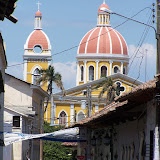
![]() |
| Sights of Nicaragua |
Tuesday, May 13, 2008
A Real Gem - Granada
In preparation for our trip to Panama with one lay over in San Jose, Costa Rica and over 20 hrs. of busing we treated ourselves to a day at the lake. A crater lake that is! Oddly enough it reminded us of home because the of the clean freshwater!!! It was warm and sunny and I am certainy got sun kissed! There were sit on top kayaks that we took for a ride. It got a little wavey while we were out so that was fun. We read books in the hammock and floated about in inner tubes. What a life, ehhh!?!?!
Jay has been into the cigars lately! Conviently there are several shops in town. Yesterday we watched cigars being made by hand. It was quite a quick and efficient process. It was with spritzing the leaves with water to make them soft. Crumbled leaves are then packed inside and everything is wrapped together. Neatly trimmed leaves are used for the final touches. It is set in a press for about 20 minutes. Somewhere along the way the identification sticker is placed on it. Jay has thoroughly enjoyed the labour of their hands.
![]() |
| Granada |
Monday, May 12, 2008
A home at last?!?!
Jay has improved the computer system at the Nehemiah center, which is a collaboration of 9 different mission organizations that operate out of Managua. The unique thing about this group is that locals are involved and active in a huge part of what goes on. Jay learned more about routers and networking. He also discovered a new program called Ubuntu. Dave (the guy who became our contact and toko care of while we were there) and him have had an excellent time learning how it works and creating an installation CD for the whole office. Many evenings were spent talking computers, trying to trouble shot and bouncing ideas off each other.
I was working with kids with disabilities. It was spectacular. The kids vary in age and what brings them to the center: everything from autism to hyperactivity to developmental delays. I really enjoyed the one on one work that I was able to do with the kids. One of the teachers took me under her wing and was glad to have an extra pair of hands. She taugth me a half hour session designed for kids who have problems speaking. It is ways for them to exercise there jaws and mouths. By my last day there the kids were calling me teacher. I was quite honoured. Michelle is the over seer of everything imaginable and she`s a busy woman. We had alot in common and we were able to encourage each other.
Now for our social life... Sunday we went to English speaking church. It was so good to be able to sing along. We spent an afternoon chatting with acouple about Peru and eating ice cream. Then we played ultimate frisbee and hung out with a group of people our age at their sweet apartment with a pool. They have a spacious kitchen so I made pizza for everyone. Another night we were invited to a dinner where a guy spoke about his recent trip to Isreal. Tuesday night Michelle and Dave took us out to dinner. I had a passion fruit margurita. Yummy! Wed. nights were busy as there was soccer and Bible study. It is such a wonderful atmosphere to be a part of.
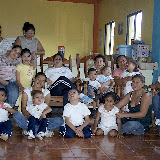
![]() |
| Volunteeri |
Sunday, May 11, 2008
Un Paro De Las Transportistas - Transportation Strike
In this part of the world there aren´t many unions that are as organized as the ones at home, particularly the Nicaraguan public transportation organizations. The ''transportistas'' are a collection of individual drivers and cooperatives. This means that a nation-wide strike takes a while to actually get going (if it happens at all). So we wondered - will the strike actually happen? if it does, who will stop working (taxis, busses, microbusses)? what kind of demonstrations / blockades will happen? are we going to get stuck in Managua indefinetly until this thing gets figured out? Managua has been fun, we´ve met some amazing people, but weren´t particularly excited about being there until the slow-moving wheels of Nicaraguan politics sorted things out.
Monday morning came and went, our busses to the Nehemiah Center worked just fine, so we thought maybe things had blown over. But, then came Tuesday morning - the day we were hoping to go to Granada. Very few taxis were on the road, and the ones that were looked rather nervous. On the news we saw crowds of drivers surrounding working taxis at intersections, taking their 'Taxi' sign from their roof of their cars and writing 'Al Paro' on their windshields. 'Al Paro' translates directly as 'To The Strike'. The word was there actually was a wide spread strike happening. Officially all taxis and busses throughout the country (except within the city of Managua). This meant, no busses to Granada - at all.
The only thing to do was to shoulder our packs and see if we could find somebody willing to take us to the Tica Bus station. Our plan was to try to hop a ride with this international bus line to Granada. We hoped this Costa Rican run bus company wouldn´t get involved with a Nicaraguan strike. We did find a taxi driver, who after picking us up changed the sign in his front window to ''out of service'' to be less consipicuous (though we thought driving 2 gringos around was fairly obvious). We got to the Tica Bus station without incident and then I went to see if we´d be able to get a ride with them to Granada. The guy at the front desk tried explaining to me that this wasn´t possible because the busses from Managua didn´t stop in Granada. But - he knew a guy. ''Great,'' I thought, ''everybody know´s a guy, and they always have the best price, with the safest car.... but we are pretty stuck.'' So we agree to have him call his buddy who will drive us to Granada for $30 (OUCH!! the microbus we were hoping to take would have normally cost us $3). A few minutes later ''the guy'' showed up in his white and yellow Taxi - not the inconspicuous unmarked vehicle we were kinda hoping for. But on the up side it was a relatively new Yaris, with working seatbelts, trunk, shocks, no broken windows or crazy dingly balls all around the dashboard. All in all, the nicest taxi we have seen on our entire trip, so we decided to bite the bullet and go for it.
As we drove through Managua the roads were pretty quiet and we avoided most of the main intersections. As we left the city we saw rows of busses that normally seviced the routes south lined up along the road. As we drove by our driver pointed to some of them and said to me ''there are your busses to Granada''. Good thing we didn't go to the regular bus stop and hope one came by, because we would have been 100% out of luck. Going a little further he started to chatter away on his cell phone to some other drivers he knew, and I managed to piece together that he wasn´t actully all that sure we´d be able to get through to Granada at all!
I really began to wonder when we got to a dead stop just before the city of Masaya - the most major intersection on the highway between Managua and Granada. After unsuccessfully trying to find a way around the traffic jam (which we knew was caused by the striking transportation workers) we inched our way forward to see what the situation was. When we got to where all the busses were parked along the side of the road, and the drivers were demonstrating we could see things were relatively orderly and peaceful. None of the burning tanks of fuel, rubber bullets and tear gas we later heard got used in Leon. We did get a bit nervous and made sure the doors were locked when our car was swarmed by some of the striking drivers. But, they seemed to be satisfied with a bit of somewhat heated exchange with our driver and writing 'Al Paro' on his windshield. They couldn´t take his taxi sign because he had already put it in the trunk. After that, we were a bit nervous and on the lookout for another more serious blockade, but made it uneventfully to Granada.
Hiring the driver was expensive, but turned out to be a good move. Since then the strike has become more serious and it would have only been more difficult to find transportation. We cut short the last of our plans in Nicaragua and decided to take the Tica Bus all the way to Panama after several great days in Granada. From the sounds of things it has been making an impact throughout the country, where the majority of people don´t have cars and depend on the taxis and busses for any of their transportation.
The markets in Managua are having a harder time staying stocked, the outlying towns are having problems getting supplies delivered and rice prices have gone up (again). When asked if people are stocking up on food in the event of a shortage in the near future, a local market vendor in Managua said people are spending LESS because they´re having a harder time making money. The stike is definetly having a high profile impact, and (so far) has wide spread popular support. But, so many of the people affected (drivers included) live day-to-day, with very little (if any) savings. There is no such things as union-supplied strike pay here. How long will they be able to hold out? How long will things stay relatively peaceful? Does the government care?
One of the bus co-ops has publically stated they are prepared to strike for a month. As of a couple days ago the government hasn´t shown any interest in even talking, hoping the multi-faction strike will fall apart all on its own when everybody involved really starts feeling it pinch. The ones who feel it the most and the quickest are those who live day to day... and depends on the public transit system in one way or the other to facilitate their income. The trouble is, that is the majority of the Nicaraguan population.
What is at issue? The Transportistas want a fixed gasoline price throughout Nicaragua. Their fare prices are government regulated and after several increases over the last year the fares cannot be raised any more without putting them out of reach of those who need the busses the most. But, gas prices keep going up. Income staying equal, costs going up, how can they make a go of it?
Suspicious facts about the government's handling of oil in Nicaragua that are making people angry:
- Prices in neighbouring Honduras are significantly cheaper
- Nicaragua SELLS oil to Honduras
- Hugo Chavez (Venezuala) has made a deal with Daniel Ortega´s Sandinista government where they can buy Venezualan oil at a very economical rate, with a long term payment period, and a percentage of which they don´t need to pay for at all.
- this oil (and its profits) are managed by a Sandinista company, set up for this express purpose
- the only bus organization that receives government subsidies is the Managua City busses... which is owned by a Sandinista
- there is little to no transparency about how the profits of buying cheap Venezualan oil and selling it to Honduras are being managed. More specifically to WHOM are the profits going??
So, to all appearances, Daniel Ortega the self proclaimed 'man of the people' - Sandinista protector of the poor and down trodden - has some sneaky oil deals on the go. Who is financing them? The average bus driver, taxi driver and rural lady who needs the bus to get her vegetables to the market. I hope that the strike can shake some better deal out of the government, and I really hope that it happens soon enough that the average Nicaraguan doesn´t have to pay too dearly for it.
That being said, I´m glad that we aren´t trying to traipse around Nicaragua at the moment.
Home Home on the Range
Though uncertain about getting on and riding a horse we all had to give it a try and spent most of the afternoon doing that. Good thing they were so tame and easy going. When we were not horse back riding we were relaxing in hammocks or eating fried chicken and baked potatoes or other typical Nica food ( tostones - fried plantain, gallo pinto - rice and beans, jalepeƱo cream sauce over tender meat). Our first night we roasted hotdogs and made smores by the bonfire. Now that was certainly a taste of home!
We went to a rodeo. It was pretty comical because we all went with pretty big expectations and were all disappointed. There was alot of dancing, several horse shows and bull riding, with a little lasoing. Ohh and lots of talking. The band was awesome. People went to socialize and party mostly.
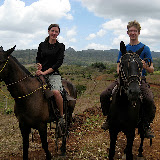
![]() |
| the Visit to the Ranch |
Sunday, May 4, 2008
My Visit to a Nicaraguan Prison
As seems to be fairly standard for the Latin American countries that we have visited, the last 100 years of Nicaraguan history is a complicated combination of dictators, puppet presidents, coups, rebellions and American interference.
The political figure that overshadows almost the entire 20th century is the Somoza dictatorial dynasty. This first began in 1936 with Somoza Garcia (I'll call him Somoza #1) taking the reigns of power, and from then on, whether directly or through puppet presidents and rigged elections, the Somozas (#1,2 and 3) ran Nicaragua until their overthrow in 1979 by the Sandinistas. Somoza #1 can claim such accomplishments as:
* orchestrating the assassination of Augusto Sandino in 1934 (now a national hero, Sandino led the rebels fighting against the intense American control of Nicaragua - which meant fighting against the American Marines until their withdrawal in 1933 and then government's American-trained-and-armed National Guard)
* in the early 1940's stealing the landholdings of the many wealthy Germans who had been in Nicaragua since the late 1800's on ranches, coffee and banana plantations. This ended up giving the Somoza family direct ownership of land covering the same area as the entire country of El Salvador
* being assassinated by the poet Rigoberto Lopez Perez in Leon in 1956. Perez left a note describing his plan, disguised himself as a waiter to get into the party Somoza #1 was attending... then shot him. Perez was immediately killed, and has been a national hero ever since.
* creating the Coyotepe Prison in 1937. This is the prison that I visited yesterday, and is one of the most terrible places I have ever set foot in.
After the assassination of Somoza #1, Somoza #2 ran the country as either president (or direct controller of a few puppet presidents) and Somoza #3 was the head of the National Guard. The National Guard continued to be trained and armed by the US, which was a strong supporter of the Somoza regime, because they were considered an anti-communist force in Latin America. The Somoza's seemed to get progressively more brutal and repressive, with Somoza #3 having the legacy of being the most terrible of the bunch of them.
By the time Somoza #3 came around (after Somoza #2 died from a heart attack in 1967) there were 3 secret prisons throughout western Nicaragua. One of which was Coyotepe. This place was originally a fort built in 1893 for the civil war that at that time was being fought between the Liberals and the Conservatives. At that time it basically consisted of a stone perimeter wall punctuated by several small towers. In 1937 it was "remodeled" by Somoza #1. The outer wall remained, but inside the walls 2 underground levels were created and filled with cells. There was a third level that is now closed up due to a collapsed tunnel, which was rumored to have been used for everything from storing munitions to bodies of prisoners. Depending on the cell size there was between 15 and 50 prisoners in each cell, where they were fed one meal a day of beans, and slept on the concrete floor. In the rainy season the floors were typically covered with water and dirt that streamed in through the smalled barred windows. To pass light into the second level cells there was a 15 ft long tunnel that was perhaps 3 or 4 feet square that ran on an angle from the top of the cell wall up to the ground level. There were bars on the cell-side of the tunnel, and a gate at the ground level. That was because these were used as a form of particularly cruel imprisonment. Up to 5 people at a time were placed here, for 1 week with no food. They were unable to stand because the tunnel was only a few feet high and the floor was on a 45 degree angle. They could not lie down because there were too many of them in the small space, so they had to spend the entire week hunched over their knees.
On the second level, in a windowless area that was almost completely dark, are the "special cells". This is where prisoners would be brought to be tortured. There were cuffs on the walls that would hold the prisoner's hands above their head while their captors utilized a vast array of gruesome techniques to extract information. They were cut, whipped, burned with cigarettes, had their fingernails torn out and more terrible things I need not describe here. The holding cells in this area were about 6 feet high, with a metal grate for a ceiling. The guards would make use of this "birds eye view" to hurl all kinds of filth and abuse down upon the prisoners who waited there for their turn to be chained to the wall at the end of the hallway.
It is not known how many unfortunate souls lost their lives in this awful place. But to give you a sense for the scale of what was happening, the first level could hold 400 prisoners, the second level could hold 200, people were rarely released, and this prison was in active use for over 50 years.
I wish that I could say the place was closed down when the Sandinistas overthrew the government of Somoza #3 in 1979... but that was not to be the case. It was to be used for the next 10 years - throughout the American funded Contra War. The first act of the Sandinistas was to make a switch: in Coyotepe the guards became the prisoners and the prisoners became the guards. Though this may seem like just punishment, even worse atrocities happened then than ever before. Revenge, though immensely appealing, did not heal. So, from the 1979 Sandinista take-over until the 1989 change of government and the end of the Contra War, Coyotepe was still a place of horror. Something that is particularly frightening, is that there is a very real possibility it will be re-opened if another war broke out here in Nicaragua.
In the early 90's it was abandoned for some time. People did venture there - stealing the iron bars, painting graffiti on the walls and holding Satanic rituals in the darkness. Government after government have stated they want to put money into turning it into a museum and memorial, but thus far the talk has not been backed by any action. Perhaps it is better this way - raw, rough and real - not glossed over or made more palatable (or more flattering to the current Sandinista government). Leaving the prisoner's desperate graffiti and (possible) bloodstains on the walls, having no extra lights to drive away the bats, moths and gloom, gives this place the ability to make a deep and non-too-gentle impact.
It is now being cared for again, not by the ever-talking-rarely-acting government, but by the Boy Scouts of Nicaragua. They are incredibly well informed guides, and keep the place under 24 hour watch to keep away those who are interested in seances or spray painting, drinking or drugs. That dedication amazes me - this is the last place I would want to be alone at night. Our guide told us some of his colleagues claim to have seen ghosts. He's not 100% about how real the ghosts they saw were - but he knows that he heard foot steps on the lower level stairs when there was definitely nobody else there. He also told of Christian pastors who have visited this place, and sensed evil spirits there. I for one, would not dispute what they sensed - this place embodies the evil that we can inflict on each other in the name of a political cause, quest for power or search for revenge. Many of the stories the guide tells are from those who were held prisoner here - who came back to see it empty - and shared their stories through their tears. So, here I have passed some of those stories on to you.
Coyotepe - a dark place that embodies some dramatic examples of the brokenness that exists in this damaged creation. It is not a fun visit, it is not a pleasant story. But, it we ignore these things and pretend these stories never happened, then how will we be prepared to act when our time comes to make a difference?
For some photos of my visit to Coyotepe, click on this link: