Thursday, May 29, 2008

White Water Kayaking in Ecuador

Rio Jatun Yaku - Tena, Ecuador
[pronounced Hatuun Yakuu]

I was blessed to be able to fulfill one of my dreams for this trip by going kayaking in Ecuador. Yesterday after church we took a bus from Quito to a little town called Tena. This 180km trip took a lightening fast 5 hours... LOTS of crazy switchbacks through the mountains and then jungles. It wasn't too bad a trip though, with only about 10 or 15 minutes where going over the edge seemed like a genuine possibility.

I was nervous and excited last night, and didn't sleep too good with kaykaing heavy on my mind. In the morning I got up and went to the Rios Ecuador shop to meet the raft trip I was supposed to kayak with. Upon arriving I discovered the raft group had cancelled, which meant for the same price ($59) I was going to get the trip anyway, but with a one-on-one guide! (this kind of thing normally costs $140 with Rios Ecuador). Sweet!

My guide Daniel was awesome: relaxed, professional, knowledagble. I couldn't ask for more. My rental gear which I was a bit nervous about really sucking, wasn´t too bad.

Boat: Dagger Redline - a bit older (late 90's?) but still a great 7 foot river runner. The outfitting was fairly old-school, but actually fit really well right with out much tweaking.

Helmet / PFD: Again a bit old school, but definetly meant for serious white water. My PFD was a nice Lotus Designs jacket - not the ghetto rafting PFDs I was a bit concerned I'd end up with.

Paddle: Crappy - a plastic Werner, which actually broke part way through the last serious rapid! I dropped into a fairly sizable hole to play around, and the paddle blade just bent away at the neck when I leaned into the low brace - no rocks or anything!

The River
The river has lots of names... Alto Napo, (Upper Napo) or Jatun Yaku (local name.) It means Big Water in Quechua, a dilect spoken by the indigenous people. The local name says it all! The river was a super fun run with big waves, wide lines and deep channels. Lots of catch-on-the-fly waves from 4-8 feet high, with hardly any really munchy holes to avoid. At different times it reminded me of the Ottawa Main Channel, Filo Bobos (Mexico), Lower Gualey (West Virginia), Pescados (Mexico) and Ruper (Quebec) rivers. There were moving flat sections after each big rapid and very few rocks. It's a perfect comercial run - safe, low consequence while still being fun and exciting. Since I hadn't been paddling in several months it was a perfect river to get back into kayaking with, a great big water class III.

Rio Jondachi and Rio Hollin
[pronounced Hondachii and Hoshin]

The night after paddling the Jatun Yaku with Daniel, I met a great guy named Tim who is actually one of the family members that pioneered the white water kayaking industry in Tena 15 years ago. At that time all Tena consisted of was a few dirt roads and thatched roofed huts. It turns out he that the next day he was running a river to test some radio gear with one of his senior guides (Victor.) The river would be a class III+/-IV and he invited me along for the cost of splitting gas - which I was super excited to take him up on!! So, I rented a Jackson Rocker (and a much better paddle than the first day) and was raring to go come morning.

The drive to the put in was gorgeous, and the hike down the canyon to the river was a steep, slippery 40 minute above-your-ankles-mud-stomp. The $3 employing one of the locals to carry our kayaks down qualifies as some of the best spent $$ of the entire trip!

It rained for most of the day, making the paddling more beautiful. There were all kinds of waterfalls coming down through the lush jungle vegetation on the canyon walls right into the river. In many ways the Rio Jondachi was like the Barrance Grande (Mexico) - a solid but not too crazy class III read-and-run boulder dodging river. The river was challenging enough to be interesting and low stress enough to be totally relaxing and enjoyable. The river's beauty is merely magnified by it's remote nature.

It is a minimum 2 hour hike from the few emergency exit points of the river to the nearest village, where there is usually cell phone reception. Then even farther before you get to the nearest road. River People - Tim's family's company - is the only company solid enough to run comercial trips here. From what I could tell, they are definetly the most pro company in Tena, with standards in many ways equivalent to Esprit.

When we met the Rio Hollin the river changed dramatically and became pretty solid big water. I didn't adjust quickly enough, and got pretty spanked through a couple big hydraulics in the first major rapid!! No swim, no harm done, just a pressure washing of my brain and some hoots and laughs from the guys! This clearly showed me I had to be more on my toes for this next section of river. It was a total blast. This section of the river was big water rapid after big water rapid - and definetly some holes you didn't want to go into! The best comparison I can make for Ottawa river folks is a river full of Normans & The Lorne with small flat sections in between rapids, with out the flat water paddling.

Kayaking in one of the most beautiful places on earth and spending time with a couple really cool, chilled out guys was an extreme blessing.This has definetly been one of my favourite days of our entire trip!!

Wednesday, May 28, 2008

When Art Matters

Ohh one thing that I forgot to mention about Quito is the cultural hub that it has become. The arts are important here and it is obvious as music, drama and art is easily and financially accessible to all.

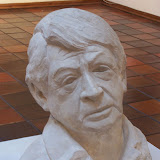
We spent a day visiting two sights that commemorate the work of a local artist. The first was "The Chapel of Man" a gallery Oswaldo Guayasamin had designed to house his paintings. His modern artwork focuses on the human body, mainly hands and faces to depicit the struggles and achievments of people over time. Mainly it is a tribute to Ecuadorians and South American but it also includes work that was inspired by visits to India, Nicaragua, Chile and Africa. The emotion that is evident in each piece is pognient and fierce. His work well thought out and expressive.

The second was a museum that housed the artists collection. When he passed away he donated his home and his collectionsto the people of Ecuador. There were three main sections: Pre- Columbian art (which consisted of pottery, jewellery and items used for rituals) Contemporary art (which was mostly religious and include over 40 different crucifixes) and a best of collection (containing portraits, murals and work that he had done.)

Oswaldo Guayasamin - La Capilla del Hombre

Quito - One of South America´s Best Kept Secrets

After a wonderful evening out Jay and I both agreed that Quito, Ecuador´s capital with a population of about 2.5 million people, at an altitude of 2850m reminded us of home, of Ottawa. Sort of strange isn´t it! We enjoyed a Greek stule meal with a gentleman who we´d just met on the plane and his wife. They treated us at one of the most well known resturants in Quito because the view of the city from the terrace is spectacular. Those images of our first night and many other new ones have confirmed our initial reaction. Quito is a great city.

Here are a few of the highlights of the city:

  • The old city, as it is affectionately known by tourists, is the heart of the city. It is a labiryth of churches and convents. A local family who has travelled the world bragged that the Notre Dame Cathedral was disappointing compared to what they are used to back home.


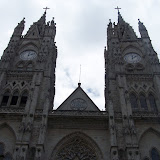
  • The Basillica has a few old and rickety bell towers, but that doesn´t mean you can´t climb them. Jay braved the poor infrastructure and got to the top anyway.


  • We found an English speaking church. We were warmly welcomed in and a later we´ll be volunteering at the youth camp.


  • Mariscal Sucre is the party district, sort of like the market downtown. Conviently that is where our hostel is located. There are all sorts of resturants, bar, stores, and travel agencies. They´ve figured out that tourists are a key clients in this area.


  • An old Jesuit church is laiden with gold and symbolism that the guide tried to help us understand. When we visited they were celebrating the life of one of the local saints.


  • We saw a local indigenous group protesting outside the Governor´s Palace.


  • Once again we feel at home in the central park that is bustling with people, vendors, musicians and shoe shine boys. To top it off the park is well manicured and the fountains work.

Those are just a few of the fun things that we took in. We´ve enjoyed the people, the scenery and the weather. It´s worth taking a vacation to!


Visits to Old Quito Buildings

Tuesday, May 27, 2008

Panama Canal - A Wonder of the Wolrd??

So for all you critics and hard to awe people out there I suggest you pay close attention! Prepare to be amazed. I wish you could all come to visit this great site at some point. For the time being the summary and photos will have to do.

This is a look into a canal that geographically splits a country in two. It was built in the early 1900s with full operations starting in 1914. They used the top line technologies of their time, primitive to what we know today. And the best part is that some of the originals are still in use today, mainly the lock doors that open and close to change the water levels. Some of the parts of have been updated over time, such as the mechanisms that open and close the doors and the cable cars that guide the ships through.

Here are a few random facts about the ins and outs of the canal:
  • The boats alot 24hrs to complete the journey across the oceans. Most of the time is spent waiting their turn. It takes 8 to 10 hours to go through the lock sets.
  • The most expensive boat to go through was a cruise ship in 2007 who paid $330 000. The world record for least amount paid goes to a 140lb swimmer at a grand total of $0.37. In general the fee is determined by type of boat, length and weight.
  • There are two reguirements for the boats to pass. The first is that the money must be bank transfered a minimum of 48 hours prior to crossing. The second is that the captain gives up the helm of his boat to a canal pilot who gives instructions while at the locks.

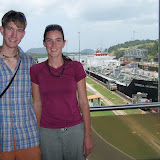
We arrived at the Miraflores Visitor´s Center at the perfect time. It was 9am and things were just in motion for a huge, full cargo ship. It was 4 hours later that we peeled ourselves away from the look out decks and went inside to walk the museum! While we watched the ships cruise their way throughs the locks a guide with a microphone was spouting out random facts about the canal. It was in English and Spanish. We learned alot and enjoyed the activity.

Panama Canal


Sky Scrappers and Abandoned Buildings

"Panama City is something of a hybrid of Miami, Central America, and the Caribbean, a city of banks, large stores, luxury hotels, ancient ruins along the seashore, and a densely populated downtown area where Asians, blacks and native Panamanians co exist in a noisy, colourful cultural mix."

* from a book called "The Country Under My Skin¨ by Gioconda Belli

Well there is nothing like entering into a large city after spending alot of time in smaller, rural places. Our first impressions were an intersting mix of being excited to see green space and wondering how the obviuos poverty and a worn down feel can co-exist with so much wealth. Panama City is the place where we have experienced the most contradictions and obvious contrasts between social classes. The history is complex, like most of Latin America. However what helps it stand apart is the canal and how that influenced the people and the country´s development.

The Old City
Our first stop was a large pedestrian only road lined with stores on both sides that stretched for quite some distance. You then had to brave one of the sketchy parts of town, it´s run down and people don´t have much at all as they stand in the decaying frame of a once elegant doorway. But a few blocks later there are beautifully restored churches and museums. Weaving your way through the streets you come upon an old pier that served as the look out port of the city back in the day. There are great walking paths with amazing views of the ocean, the boats and the city. When the tide is out there is rock in every direction.


The Causeway

A wonderful place to spend a warm, relaxing afternoon. A cheap 15 or 20min taxi ride of $1.50 gets you to group of 3 small islands that are connected by a palm tree lined road and walking path. The ocean can be seen all around, along with the sihilloettes of boats waiting for their turn thru the canal. It is picturesque, with locals walking or biking along the paths. By the time we arrived at the last island we were overwhelmed. Feeling like we´d landed in another world. One where there was abundant of wealth, evident by the yacht clubs and huge boats that were strangely mixed with abandoned resturants.

The Ruins

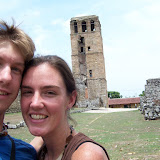
Remants of what used to be the original city stand along the ocean and a huge highway. Surrounded by parks and distance sky scrappers the 16th century buildings look a little out of place. The best preserved piece was the bell tower from the church. It all so served as a look out to get a great view of the city.


Aside from all the sight seeing we took time to enjoy our air-conditioned room that had cable TV. Ahh the luxuries!!!


Panama City

Wednesday, May 14, 2008

Sights and Sounds of Nicaragua

Language and Culture

  • The Spanish spoken hear is the most difficult to understand yet. People say that if you can learn here you are set. It sounds like everyone has a mouth full of marbles. People rarely pronounce the "s" in words.
  • Not everyone is nice. In general the people in Esteli weren`t friendly or polite.
  • Some people here have blue eyes. It is amazing to see them with their dark skin and hair.
  • There are few street signs so people give directions using landmarks.
  • The street food was not appetizing though the traditional food was yummy.
  • People live behind huge, complicated gates. They pull out rocking chairs out to their patio at night but sit behind them.

Entertainment

  • If you are bored and looking for some evening entertainment there are casinos every few blocks. They seem to be into slots mostly.
  • Shoes are a big thing here. You wouldn`t think that Payless Shoe Stores would be the shop of choice but it is!
  • We attended our first English speaking church since we left home. Hallejuah!
  • Don´t try this at home. We hypnotized a chicken. We had the most giggles while we tried to catch it.

Transportation

  • Public transportation is a way of life for people in Nicaragua. You generally have 2 options: the chicken buses (old NA school buses with a new paint job and some gaudy decorations) or micro buses ( little VW vans). In either case if you are a gringo they try to steep up the price. We lost big time our first day going to the Nehemiah Center by paying 20 Cordobas. A local would pay 5 -7 Cords!
  • Safety is on everyone´s minds, locals and tourists alike. A Nicaraguan worker from the Nehemiah Center was robbed and abandoned out on a country road by a taxi driver whose friends ( also in the car) had a gun. They assume that it was not pre-meditated.
  • The popular vehicle of choice among the missionary community was a 4x4 Land Rover. The models varied but they are heavy duty.
  • Our best laid plans got thrown out the window when there was a country wide transportation strike.

Politics

  • On the political scene: People hate the Samozas but the Sandinistas are not angels either. It makes the Conseratives and the Liberals look pretty good.
  • We were eye witnesses of the largest poverty gap between the rich and the poor in Central America.
  • The infrastructure is minimal. Not all places hvae garbage pick up, so they make a pile on the street and just burn it there instead.

Random

  • We experienced several power and water shortages. It is a part of life here. There is not enough power and the lack of organization makes it difficult for people to predict when it will occur.
  • In Matagalpa we stayed in the smallest room yet. It had a 2 ft. wide path to the bathroom and the rest was taken up by the bed.
  • There are lots of security guards with guns and metal detectors. Who knew that a shot gun was necessary to defend a bakery!?!
  • They make great cigars. You could even watch them roll `em up in Granada.
  • Managua has the record breaking high for temperatures. It was easily mid 30s C most days. The muggyness rarely left.


Sights of Nicaragua

Tuesday, May 13, 2008

A Real Gem - Granada

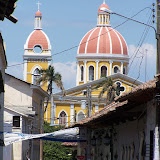
The scenery and the food were a highlight here. Our first afternoon we wandered the streets. There are several old churches. We climbed up the bell tower of one to get a sweeping view of the city which is on a huge lake. Another afternoon we went and sat in a park by the water. We enjoyed waffles and homemade bread for breakfast. The people where hard working and the drivers of the horse and carriages where often trying to get us to take a ride.


In preparation for our trip to Panama with one lay over in San Jose, Costa Rica and over 20 hrs. of busing we treated ourselves to a day at the lake. A crater lake that is! Oddly enough it reminded us of home because the of the clean freshwater!!! It was warm and sunny and I am certainy got sun kissed! There were sit on top kayaks that we took for a ride. It got a little wavey while we were out so that was fun. We read books in the hammock and floated about in inner tubes. What a life, ehhh!?!?!


Jay has been into the cigars lately! Conviently there are several shops in town. Yesterday we watched cigars being made by hand. It was quite a quick and efficient process. It was with spritzing the leaves with water to make them soft. Crumbled leaves are then packed inside and everything is wrapped together. Neatly trimmed leaves are used for the final touches. It is set in a press for about 20 minutes. Somewhere along the way the identification sticker is placed on it. Jay has thoroughly enjoyed the labour of their hands.

Granada