Monday, February 11, 2008

Holy Mole

More about food and eating... Hope you aren't hungry, because you might be after this!!!

Mole (Mo-l - ay is how you would say it phonetically) is a food that is reserved for fiestas. Molle is a paste that is create from various spices, chilies and cocoa or chcolate!! It sounds strange and it is. It doesn't taste bad, but it is unlike anything you have ever tried before. They make it into a sauce that is then used to marinate meat, usually chicken or turkey. You can make your own or buy it at the store or in markets. There are all sort of varieties that change depending on what is added to make it.

Tostados are one of my favourites. It sort of seems like it is a healthy choice, if they exist here in Mexico. Unless you make your own food I think it is safe to say that it is hard to get away from their deep frying ( finally some competition for all that dutch blood!) The base of a tostada is a crunchy toasted or deep fried tortilla. At our second host family they would take day old tortillas and microwave them. With all the moisture out they are crunchy goodness. The next layer is refried beans, which are the consistency of paste and taste yummy. Then toppings are added. In this area lettuce, tomatoes, advocado, pulled chicken and a crumbly cheese are placed on top. Sometimes for a final touch the tostado is garnished with crema ( a cream equivalent that comes in a small tetra pack.) So the trick with these is all in how you eat them. You can't use a fork and knife and invariably part way through the base tortilla is going to crack whether that is above a plate or not. Ask Jay - the first time that we had them with our host family he broke his with the first bite and it fell all over the table.

Ensalada would be the most healthy food choice in this area. You guessed it... salad, that is served on a plate. They only make it for gringos (white people.) It is lettuce, tomatoes and cucumbers. Lime juice is squeezed over it, rather than dressings. Because the water is poor quality the veggies are often washed with an iodine cleaning solution. The classy resturants will have that documented on their menus.

A taco is on of the most deceptive foods you will find on a menu ( if they have one.) Tacos are not the hard shelled, prepackaged, tasteless items you get back home. I use the word deceptive to describe them because I have had many tacos and they have all been different, primarily because the base is different. Sometimes the tortillas are deep fried, other times it is hot or cold. The tortilla is usually a little bit smaller, ~ 8-10cm across. Either way one or more ingredient is placed on top and you fold it in half to eat it. The most delicious ones here are chili spiced pork with cilantro sprinkled on top. You then add a little lime juice and salsa, and you are good to go. The toppings could include fruits, veggies or meat.

Tamales are steamed corn dough wrapped in a corn husk or dried banana leaf. The dough is usually stuffed with something: meat, veggies, beans, chilies or there is a dessert one filled with raisins and sweetened milk. The first time I had one it was disguisting. The texture was just too much. I have since tried more, they aren't my favourite but... The last one I had was stuffed with pork, a tomatoe based sauce and 2 types of olives.

Continueing on the corn ideas... A must eat in this area is the wheelbarrow corn. A wheelbarrow with wood and coals is pushed around town. When you are ready a cob is grilled and smothered with lemon juice, salt, mayo and chili pepper. It is then rammed onto a large stick. It tastes delicious. You can also get this combination in a cup ( with kernels of corn) or on boiled corn cob.
Enchiladas are tortillas dipped in a hot sauce, filled with goodies and then fried. After a collection of them are fried it's smothered in salsa or sour cream with cheese on top. Quesadillas are similar to home, except that they would be served with cheese predominantly. What makes quesadilas and burritos stick out is that they are made with flour tortillas ( which is why Jay likes them so much.) The cheese here is different than at home, ohh and they tend to drink milk warm ( haven't gotten used to that.) Unpasteurized milk from galvanized milk cans is available from vendors biking, driving or walking by. The two common cheese are Oaxacan and. Oaxacan is stringy and formed into big balls. It tastes similar to Mozerella but with more body. The other is crumbled and has a fairly strong taste.

Dessert isn't as big of a deal here. But they have a few substitutes. Flan and jello are big. Churros are a distinctly Mexican delight. The raw dough is squeezed through a pastry shaper such that it is about the size of quarter and 15cm long. It is then fried and rub in sugar. They also deep fry bananas and top them with sprinkles, jam, chocolate or carmel sauce, sweetened condensed milk or cream. If it is a hot day you can get sherbert or fruit popsicles. They are made by hand with real fruit juices and chunks. A few of our favourites include; lime, pineapple and coconut. So delicious.

Sunday, February 10, 2008

Street Grunting Anyone?

Street Grunting... This term is not an original of mine. I got the idea out of the book "People's Guide to Mexico," which is an anecdotal introduction to Mexico. As they say, "Street grunting covers everything that doesn't have to be eaten while sitting at a table...It is an entire system that eliminates much of the hassle and time involved with ordering, menus, tips, and other restaurant rituals." It is a great way to eat out. It is cheap (usually you couldn't make it at home for the prices they charge.) We usually wander the streets or sit in the zocalo with our finds.

Now would be a great time to introduce the idea of streets vendors. After dark the streets are transformed. People drink beer in groups outside their homes. Plastic Sol tables and chairs are placed on the roads ( cars rarely drive on them anyways - at least here in Jalcomulco) and a large propane tank is attached to a variety of strange stoves. Temporary resturants appear each night. Those families that sell out of the main square (rather than their homes) often have a special bike or covered hot dog like stands. These people sell pretty much any sort of snacking food: hotdogs (fully loaded), hamburgers, tacos, empandas, corn, sweets, nuts, drinks, fruit, popcorn, pork rind chips, sherbert, potatoe fries, deep fried bananas and pastries. There are also people who wander or bike around town at various times of the day selling cheese, chicken (it's raw and not refrigerated), yogurt, and breads and sweets from the local bakery. They often have a large basket that is carried on their head. Jason has this theory that if you stay in the main square with a decent amount of money and enough time and patience you can get anything you want without even having to leave your bench...foods, drinks, souvenirs, tour bookings, bar/resturant recommendations and of course Spanish practice.

Since they sell things on an as needed basis people don't have menus. The more permanent places have signs or posters that show or have written what is offered. Other places you just have to guess or point to your neighbours and say I'll have one of those. Mexicans are known for not always have everything that would be describe on a menu. So it is better off sometimes to ask them what they do have.

Our favourite food place to visit is the panaderias or pasteleria. Pan is bread.... so it is a bakery and pastel is cake .... which refers more to pastries. Either way as you enter in you are greeted with delicious smells. In Jalcomulco the bakery prepares its' goodies for the afternoon, oddly enough 4 o'clock is the best time as they prepare only enough for that day or two. To purchase anything you grab a tray and a pair of tongs and select as much as you think is healthy. Let me tell you that margin has increased dramatically for us. Typically each item (cookies, a bun, muffins) is $0.10 to $0.30, a loaf of bread is $0.60. In San Cristobal you could get a slice of cake or pie for $1.50. Here things are more basic.

One of my most favourite food experinces happened in San Cristobal. We were watching a mariachi band in the park. It was beginning to get cold. We passed by a table that was lined with large drinking glasses. Each one had a spoon inside. The lady behind the table promptly asked us if we'd like ponche. After adding a few layers of clothes we got the hot drink. Jay got pineapple, which had sweet bread crumbled into it. Mine was a mixture with big chunks of fruit in it. You could get it for here or to go, hence all the cups. They just give 'em a rinse and then it is someone else's turn. What a great idea. The other event around here is going to Juan's. He's a local, who with his family prepares empanadas, tostadas and tacos out of their front room or on the street. We often go and hang out there as a big group. If he doesn't have any beer in the cooler you just walk down the street and buy your own.

Wednesday, February 6, 2008

Beans and Rice and Limes and Salsa

I love to eat and thankfully neither of us has had any major intestinal problems. So I thought it would only be fair to include some explanations of what Mexican food is really like. Sorry for all of you out there that like Mexican food back home, you may be disappointed with some of my descriptions as it's so much different here. Part of the reason may be the amount of work and time that go into preparing the traditional dishes. Another random tidbit of information worth mentioning is that the food is spicy only once a salsa is added. Most of the time you as the person consuming it are the one who determines what kind of salsa is added and how much. I'll also include a story about learning to make Empanadas ( a deep fried Mexican pizza pocket.)

Corn tortillas, along with beans and rice are staples. Despite a few common ingredients many dishes and styles of cooking change depending on the area that you visit, add a few extra chilies here and throw in a different ingredient there. Corn tortillas are one of the most versatile of foods, though it also is one of the strangest tasting foods. For foreigners it often takes time to get used to the taste and texture. Now what you gotta remember is that these suckers are not the flour jobbies that we get in Canada. The round, cooked corn cakes are varying sizes, but most commonly they are about 15cm in diameter. The best ones are those that are homemade, though that is a bit deceiving as there are ways to "cheat" on that process. In the past you had to start by soaking corn in lime juice and then grinding it into a paste. This formed a dough that was rolled into a little ball about the size of a two year olds' fist. You'd then hear the rhythmic tap tap as the dough is flattened with the palm of your hand. I tried it once with our host mom but a chunk of dough ended up on my hand, leaving a hole in the tortilla. It is then cooked on a earthenware or metal griddle.

The modern variations of creating a tortilla are many. Now a days they have tortillerias ( anything with "eria" means a shop or factory) that pumps out fresh tortillas. They smell delicious as you pass by the stores at meal times, lined with women and their covered baskets (people bring their own containers and they stay soft when warm and wrapped.) These same stores also sell the corn already ground. You can purchase the flour and mix with a little water at home, whenever you are ready to make them. My favourite is when the dough already made for you. The ladies show up with a sandbox toy pail and they get it filled up with the dough, which they then roll out and cook as needed. So if that is not enough options there is still one other exciting option, because you could always go to the store and get them. That is the delivery guy. You have to listen carefully for the guy driving around with a cooler on the back of his scooter/motorcycle. He makes his way all through Jalcomulco touting his horn as he passes by homes. You go out to your front door, pay him a little money and you get tortillas. Another convenience for tortilla making is the metal or wooden press used to flatten the dough into a nice circular, flat tortilla. Tortillas don't keep well so the fresher the better.

Typically Mexicans eat the main course with their hands, spoons are over rated and used for serving and salsas.. The tortilla is ripped into smaller bits and used as a scoop to shovel things into your mouth. You can use your hands to rip apart meats. It took me a while to realize that when we sat down with our host families we were given utensils, but they went with out. At first I would use a tortilla like I did in Canada, meaning that I would stuff it with whatever, roll it up and then eat it. Mexicans do that but it is less common.

So seeing as this has taken me so long I'm going to divide this up a little for easier reading. I hope that you are ready for a novel. We were able to use a friend's computer so I took advantage of that and made time to write out all my random thoughts.

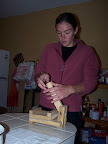
The empanada story needs to be a part of this. One of the food things that is still a little unclear is how they use the tortilla to make so many other things or do they?!? The ingredients are changed and different flours are used. They are made into different sizes and some are deep fried while others are just heated. The mystery for me is how they know when to use which one. The pictures of empanada making will certainly help with your understanding of the process and help you to visualize the press.

To make our dough we added corn flour and wheat flour together using a ratio of 3:1. Then water is added in increments as the dough is kneaded. It tends to be on the sticky side. A small dollop of dough is placed between two pieces of plastic ( almost like a tough grocery bag) on the press. You squeeze it till it is round and about 2-3 mm thick. Next remove the top piece of plastic and add the filling on half of the tortilla. In this case our filing was ground pork. Other filings have included: cheese, chicken, mashed potatoes, chili spiced ground meat or any combo. I kept adding too much filling to the dismay of our host mom. You then fold the top half of the tortilla over the filling and squeeze together the edges (it is much easier if you place the plastic back over top.) From there you added a bunch of them to bubbling, warm oil. It gets turned occasionally as it browns. They are best eaten at an outdoor vendor as soon as they are cooled enough you won't burn yourself. Since I added so much filling there wasn't enough air trapped inside and it became hard ( all this from an expert, we didn't really notice.) In San Cristobal they are served with cabbage and mayo drizzled ( dredged) over top.

Empanadas anyone? They are one of Jay's favourites.


Friday, February 1, 2008

Palenque

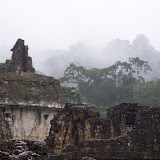
Palenque is one of the coolest ruins that we have been to so far. It was so well done by the Mayan people as it was built that you don't have to use your imagination too much. The pictures will speak well for themselves.

The highlight of this place was how it met and exceeded our expectations. We arrived to pouring rain. Now this might make you envious (oops :o) but since arriving In Mexico we've had one rain storm that we can remember. The rain lasted less than one hour and that was over two months ago. So our plan of sleeping in the jungle in hammocks was less appealing.
Instead we got a little cabana. The rain continued for two days, but that the only things that impacted was not being able to hear howler monkeys or see much wildlife. And I am still a little disappointed about that. Seeing the ruins in the rain means way less people and a more mysterious aura.

The first night we stayed there I got sick. It started with tummy cramps and in the end I was left with a cold, some where in between there was a fever. Jay took really good care of me. I was waking up every hour or two and it turned out that so was he, though normally Jay sleeps through that. Him being there to reassure me made it much more bearable.

Palenque

Market Days In San Cristobal

Okay now that you all have a better understanding of what San Cristobal is like I'll let you in on more of the artsy, fun things that we were able to do. I'll highlight two more things. The first is the markets and the second is a play/dance/musical that we went to. Jay worked hard on the pictures and hopefully you get a sense of the sights, you are still missing the smells and sounds, but that will be left up to your imagination!. No cameras allowed at the production.

The market is a thriving business opportunity for many families. They are bustling with people buying and selling all sorts of weird and wonderful things. Some of the markets are temporary, setting up on certain days of the week, while others are permanent. In S.C. there were two main ones that we frequented because they were with in walking distance. It sounded as though there were at least 2 to 5 more that were further away. Both of these markets were permanent, thought that meant two very different things. The sweets market (ohh soo good because it is deliciously fresh and hand made) was a covered building, in which people had designated stall areas. This market had restaurants around the perimeter and also sold textiles, jewelry, and some wooden trinkets. The other market was an artisan market selling similar products as the first (minus the sweets) but on a much larger scale with a lot more variety. It was outdoors. Each person had tables and hangers with a sort of over head covering made out of wood and sticks. At the end of each day ( and they had access to electricity, so their days where long, till 7 or 8pm) they would pack all their goods up and cart them home, unpacking them again the next morning. It seems like an exercise in patience!

The traditional Mexican shopping experience is to buy enough food till the next market day. For example in Jalcomulco there is a fruit and veggie market Tuesdays and Saturdays. Friday is when the clothes, music/DVDs and other random household vendors set up. People buy whatever is available on that day, even when the quality would be questionable by our standards. If they run out or miscalculate they take a trip to the corner store, which has a little bit of everything. You might have to ask for a specific product or a more fresh item as they hide all sorts of things in fridges or in a back room. From our house there are 2 stores with in 1 block and 8 with in 5 blocks. The prices are comparable to the markets. The best times to visit a market is from 9am to 1pm.

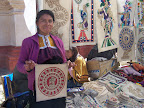
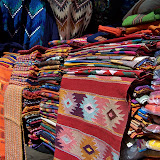
The artisan market is a treat to one's eyes! The colours and patterns of clothing and art are as lively and bright as the people that sell them. The women are the ones that come in from the surrounding villages, walking 20 minutes to an hour. I'd be curious to know what the men do, but I assume that they farm and prepare the clothes and art. The women bring their children, who often try to help or play near by. It wasn't uncommon to see a mom breast-feeding. The smaller children were slung over their mom's shoulders or backs using a shawl. Often you'd see little feet poking out the bottom. Some people were aggressively
seeking you out ( though that was more common in the streets, away from the market), while most worked on projects as they waited for you to make up your mind. One of the bonuses for us is that their wares are inexpensive compared to what you'd pay at home. The price that they quoted left little room for bargaining, though we tried. This seemed unusual. The women come prepared with food and water for the day, thought there is stalls around that sell food.

One evening we came upon a road that was pulsing with activity. It was a pedestrian only area. There was a little guy bellowing out a tune, while others set up displays of jewelry. The street was lined with cafes, bars, restaurants and shops. From our discovery day forward we just referred to it as Sparks Street. As we continued further on we were bombarded by folks who invited us to this production that we had seen advertised around town. We thought it looked good but in our general fashion we couldn't make up our minds. What about the cost? Did we really want to go? What else did we have to do? After a block of bantering we decided to go for it. Our timing was perfect as we got the last upper section (cheap) seats. What we discovered when we got inside the theatre was that it didn't matter. The place had maybe 20 rows and they used the aisle as part of the show, so actors were coming and going right beside us. Either way the price of the ticket was certainly worth it.

The show was called Palenque Rojo. Palenque is a town that is about 5 hours bus ride away. It takes quite awhile to get there as you have to go through the mountains. Now it is the site of a major Mayan ruin. Following is a direct excerpt from the brochure; " In the extraordinary lands of the Mayan, embraced on all sids by the jungle, with its exoticism. wild beasts and magic, there was an age which gave rise to two great city states: Palenque and Toninia. These two cities fought to control the commercial route from the Gulf of Mexico to the heart of the mainland. Here we present one of the most important moments of this power struggle: the kidnapping of the ruler..."

The presentation was well done, from live music to their costumes to the choreography. It is impossible to describe fully. The highlights were the animal costumes and watching how they moved about ( like the crocodile for example.) The way that the king and his assistants were dressed was also impressive, particularly the masks worn for battle. At one point in the fight against good and evil a large skeleton appeared. It must have been about 20' tall and as it got closer to the front of the stage you realized that it was actually being moved by a person inside the costume. It was easy enough to follow even when they spoke some indigenous dialect.

Here are the pictures. You may have already seen then, but they empasize what I described.

Saturday, January 26, 2008

Night Life and Other Fun Things to do in San Cristobal

So now that you know a little about the environement of San Cristobal, we`ll describe the culture. Let me tell you there is a lot!!

San Cristobal de las Casas


The first day we as we wandered the streets we came upon this lovely bakery. They had cinnamon buns and chocolate crossiants ( among other things, including homemade yogurt and organic products.) I love sweeets, particularly home made ones - they just taste that much better. As it turns out this little place was part of a "cultural center," appropriately called El Punte ( the bridge.) It offered a language school, a cinema ( a projector and a large screen with plastic patio charis to view the movies from), the bakery, a shop and a resturant which had a fireplace (that they light for us one night when we had tea, cause Jay was a little under the weather.) We certainly made good use of the place and their bathrooms (typically you have to pay for the washrooms, especially if you are not a customer.)

During our stay there we saw a total of 4 movies. Each one was $2.50 and by the end the guy just kind of laughed when he saw us come to pay. Four is alot but the movies were predominatly documentaries about the state of Chiapas, the people and the struggles that hey have had. One was also about the WTO and the impact that globalization has had on the Mexican farmers. It wasn`t flattering but you got a better view into how compliacted it all is. The other 3 all focused on the Zapitistas.

The very first movie we saw was a compilation of interviews with elderly people who had joined forces with a prominent historical figure: Emmanuel Zapata. His goal was to fight for the land that was quickly being swept up by the rich, government folk. It gave you a positive impression of what this group strove to acheive and some of the faults of the leader. The people interviewed spoke highly of what happened. In the end violence was used. This has not been forgotten by the indigenous people.

These very people who respected Zapata used his methods to create an uprising starting in 1994. The other two films explained the modern day revoltution with the Zapatistas, what had happened (disagreements lasted 10 years) and how in many ways they were unsuccessful. The indigenous people were no longer simply fighting for land, but their basic rights to health care, schooling and other such things. Currently they continue to fight for these sorts of political and economical struggles but thatnkfully it is not with violence.

The films were informative and forming. They forced us to consider what peaceful living really means. It is an understatement to say that we take health

Friday, January 25, 2008

Mexican Insights After Living with a Family

Nothing can be more exciting and strange than living with another family. We had the pleasure of spending this past week (Jan. 12 until the 19) with a Mexican family. Our Spanish has improved immensely, however we are still at a very basic level. But I no longer have to shrug my shoulders because I don`t know the words. The words can now be used to make choppy sentences.
We were introduced to the family at our Spanish school. I had mentioned that I would enjoy having kids around. Well on Sat and Sun the family kind of grows exponentially. During the week the mom (Beatrice) and dad (Marcos) are alone in the house that was passed down from his mother. They have two sons. One stills lives at home, but doesn`t eat meals there regularly. The other lives in Tuxtla, which is an hour away and comes home on weekends to visit with his kids, which he then brings home to his parents.

Beatrice sees the kids through out the week and loves to take care of them on weekends. She proudly stated that between her and Jorge (? like George in English) they have a system worked out. Jorge gives most of his attention to the grandson who is 4 years old, while Beatrice cares for the little girl (10 months old.) This particular weekend was a little bit hairy because Beatrice thought Jorge wasn`t spending enough time with the kids. She suspected that he was out with another woman. When he finally arrived back home he had a strip torn off of him for bring the tortillas home late and I suspect he may have heard a few other opinions as well. After their animated discussion, Beatrice returned to the kitchen with flushed checks.

As a first introduction to a family we felt like this was incredible and our tendency was to feel awkward. However what you don´t see is how clearly this illustrated how Mexican society thrives. I tell you this story not to make them look back but to illustrated a few very interesting cultural ideas. I hope that you can appreciate them as much as we have.

The first is that the women are the backbone of the culture. In the past there has been a traditional image of a indigenous man sitting against a cactus with his sombrero tilted over his eyes, passed out for a siesta or from drinking too much. Though that is far from accurate in most communities ( this morning I was out for a run and was passed by numerous men of all ages on their donkeys on their way up to pick coffee beans or oranges.) As Beatrice demonstrated by her harsh reprimand of her 30 something year old son, the family ties or some might say, a tight motherly grasp, never really disappears. It is sort of like you need their permission before you do things or there are big consequences.

Family means a lot and therefore the motherly attributes are embellished. Moms know everything and they do a lot. They spend hours caring for their spouses and children. At my house you ate whatever was placed in front of you or went without. At one point Beatrice was making three different meals. One for us, here son( because he only liked it with cheese) and another for Marcos. Such dedication is admirable. They go to great lengths to make sure that you are cared for. At that often means juggling many things. The women often run stores or restaurants out of their homes to make a little money on the side of house cleaning and family duties.

When things do go wrong they are less likely to be covered up. Instead they are openly discussed, with whomever and that usually includes the extended family. Their sense of pride allows them to easily admit their short comings, more easily than the Canadian or American psyche. In part that may be due to their openness.

Mexicans are affectionate. Often you see couples trying to hide in a dark corner of the park to be by themselves. A typical greeting is a hug with an imaginary kiss blown on one check. The guys have a high five and knuckle knocking hello worked out. The first time the other son arrived home he greeted his dad with a huge kiss and a bear hug. It is great fun to people watching Mexcio.