Wednesday, March 26, 2008

Miracles !?!?!?! Something Unexpected .....

After an afternoon of wandering the main street in Panajachel we discovered that a volcano tour cost $50/ person. Thinking that was a little steep we asked Julio about it. By the evening he'd convinced us that him and his brother would be our guide to hike up a different volcano that was higher (3158m) and closer to home. What I didn't realize until afterwards was that he'd never hiked it himself. There are two volcanos right beside each other. He'd done the other one, which is even higher and even that had been 8 years ago. He figured that the shorter one would be easier, but we discovered that it was less travelled. Julio's sister joined us on the hike, this was her first time up a volcano.


We parked in the nearest town and said good bye to the family that would watch out for the van. Their last words were we'll see you tomorrow. Their advice to us was to hike for 4 hours and then turn around, where ever we were. We set out with 1 o'clock being our latest turn around time. The first 2 hours were through fields of corn and coffee. It was steep going and hard for me to imagine the farmers hauling their goods back and forth. We saw men carrying out large rounds of trees on their backs.


We reached a great look out spot where you could see the lake and the town below. From there the terrain was more difficult and the path needed to be cleared with machetes. Pines tree needles made our grip tricky and then we got to the cloud forest that was dense. The clouds were so thick that for the last hours we couldn't even see the top.


Well 1pm came and went. At 2 o'clock we finally sat down for lunch, though we'd had many breaks as we hiked up. The brothers weren't ready to give up and said that they'd go ahead and check the trail. Julio hollered down for us to come meet him. At 3 o'clock we caught up with them. We hadn't reached the top. What were we to do? Well the options were less than great, unfair was how I described it to Jay while I was frustrated. We could go back and do the last part in the dark or we could go to the top and spend the night there. It was cool and we were tired, but we decided to brave going to the top, realizing that it could be cold and that we had only a little food and water.


By 4 o'clock we were at the top. It was totally cloudy and thick underbrush seemed to cover every surface. We wander around in search of a place to lay our heads. After clambering up and down a few hills and through forest galdes we discovered a clearing that had a fire pit. Long ago someone else had been there and left behind a lighter. With several attempts and a few breaks in between we got a fire started with the rusted out and low fluid lighter. Julio got on his knees and prayed thanking God for the fire. With a renewed spirit he complimented us all on working as a team to get to the top.


We prepared as best as we could for the night that lay before us by gathering fire wood and making a thatch lean to. We rationed the bread, watermelon and water. The beignning of the night went by quickly. The chatter reminded me of family camping. There were times when the clouds cleared and you could see stars and the nearly full moon. Jay got in a few hours of sleep. By midnight I was cold and exhausted so I just started to cry. Our supply of wood was nearly gone. And the wind had picked up. The brothers got more wood and piled pine boughs around to ward off the chill. The siblings took turns tending the fire. They gave me the hottest spot and wrapped us in newspaper to warm us up. But by 5ish the wind was violent, everyone was awake. Unfortunately it was cloudy again and rain was spitting. Who knew when it would clear so we waited and ate the rest of the bread. By 7 we were on our way.

Food, warmth and a bed are great motivators for tired people so we made it down in record timing. The last hour everyone was quite. What took 7 hours to climb up we descended in 4.5 hrs. We slept for 11 hours that night and woke up to stiff muscles. There were a few little warning signs along the way that we missed but this was a crazy adventure that Jay had always dreamed of. Though it was tough we remained positive. Though staying on the top of the mountain had not crossed our minds, it was totally legitamate in everyone elses . We learned so much about the Guatemalan way and we well cared for given the situation. And now we are going to carry matches around with us, just in case!
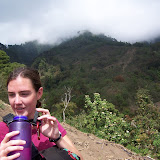


Volcan Toliman (Volcan San Lucas)

Tuesday, March 25, 2008

Lake Atitlan - A Taste of Traditional Mayan Culture

Early on in El Remate Jay struck up conversation with a woman who ran their artesian shop and conviently sold large garrafones of water. The owners (Sylvia and Julio) had long ago decided to leave their hometown in hopes of making a better life for themselves and their 3 kids, the oldest, a boy is 7 years old. However it turned out that Julio was going back for a visit and to purchase items for thier store. Jay showed a little interest and before we knew it we had an invitation to join Julio. We were thrilled. Spending more time in places we are drawn to but seeing less has become our travelling philosophy. So this opportunity fit the bill perfectly.


After the most crazy bus drive we've experienced yet ( hills, steep roads, construction and blind corners took on a whole new meaning for this crazy driver, whose assistant spent more time hanging off the roof or out the side door than in the bus) we were glad to land safely in Godinez. The mountainous area we are currnently in is refered to as Lago de Atitlan, found in the Northwestern Highlands of Guatemala. There are over 12 little towns bordering the lake, along with several volcanoes. Panajachel the largest community with a poluation of about 15 000 people is a tourist haven. The main street is lined on both sides with Mayan handicrafts of all kinds but once you leave behind the party atmosphere created by catering to tourists the mentaily changes. Hardworking people who have experienced what it is like to have little, value all that they have accomplished. The looming memories of corrupt rulers and surival in a time of unpleasant circumstances are not far off. In the streets the sound of laughter or dickering at the market awakens your senses and you begin to experience a world full of ancient traditions with modern twists.


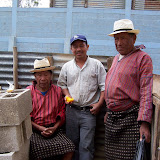
Though often dirty these slightly curious people greet you as they take shy galnces. Behind their traditional clothes ( long colourful wool skirts held in place by handwoven belts and eleborately embrodered roomy shirts for the women and girls, black and white skirts or bright blue knee length shorts with equally cheerful pants worn underneath by young boys or older men, while the men sport cowboy hats and typical farmer garb) they are a people with deeply held beliefs and graciuos, generous spirits. Cornfields, terraces and large pine tress dot the hillsides. The temperatures are on the cooler side, a welcomed relief for Jay.

We've been generously taken in by Julio's family. One of the brothers is in the States working, so his house remains empty, until we moved in! There is hot water and a comfy bed. The people in Godinez aren't really used to tourists so it has been fun getting to know our way around. There isn't a working kitchen in the house so we eat out. It has been great eating street food and discovering some yummy resturant food. Our favourite breakfast is a hot "mush" rice drink and they make a chocolate flavoured one as well. The flavour reminds me of Chia Tea. The ladies also prepare corn tamales. It is heavy going down but easily tides you over till lunch.
Julio has struck a great balance of being a friendly guide and letting us loose on the town. He realized early on that with few instructions and ideas we can get around and keep ourselves entertained. Some days we explore with him and other times we just do our own thing. We've seen several different markets, eaten pizza and burgers ( our favourite home comfort foods), hiked, watched movies, read and taken all sorts of public transportation ( which is entertainment in itself).


Lago De Atitlan

Tuesday, March 18, 2008

El Remate ........ El who ?!?!?!??

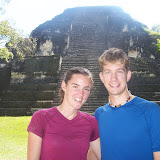
So we spent one week hanging out by a lake. The place is called ... you guessed it El Remate. I don´t know what that means or if it is something special, but for some strange reason I really find this name funny. It is in Guatemala. The area is famous because of the Tikal ruins. Following are a whole bunch of pictures of the ruins. It is popular because it is one of the largest Mayan complexes. Here are a few of the highlights of that trip.


  • A taxi driver came to our rescue. We originally planned to walk from the corner to town (about 2km) but in the sorching heat he convinced us. It turned out his sister owned a hotel and we went there. It was a huge, clean room and they ended up giving us a discount. They took good care of us. We used their phone and fridge, they gave us a great deal on the taxi rides that we took, loved to chat with us and just made us feel at home.
  • The first night at our hotel we came up and hung out with a group we'd met in Belize. It was so great to share random ideas and stories over beer
  • Your price of admission to Tikal is expensive, about $20 ( more than a good, hearty meal for two people.) But if you buy it after 3pm it is also good for the next day. We`d heard about watching the sun rise or set from the highest temple ( 64m high, built in 700AD) , so we thought it was worth it. What nobody told us was that the temple was under construction and had scafolding all over it, such that you could only see one side, and it was not the side the sun set on! But for a small fee (otherwise known as bride) to the very official looking security guards with guns, we could climb under the railings and watch from side with a view. It was worth the extra money.
  • The next morning we got a Spanish guide - Israel ( as recommended by a friend and taxi driver who came to our rescue as we stood by the side of the road on our first day there, well we hadn`t even made it there.) With him using simple Spanish and speaking slowly we were able to understand almost all of it. What an accomplishment! We are so proud and feel liberated because we can now express oursevles and chat with people.
  • We were also impressed with the unexcavated sites. Israel often pointed them out. It is amazing to wonder what is hidden beneath layers of dirt and stones.
  • Israel has been a guide in the park for 18 years. Around the back of the 'Lost World Pyramid' was an entry way that was closed to the public but not locked, which meant that we could sneak in and see two large jaguar masks. These masks date back to 250 BC!
  • Aside from the grandeur of the pyramids there was spectacular wildlife. As you'll see by our vast number of attempts at capturing pictures of spider monkeys, we were fascinated. You'd be walking and hear rustling of branches over head. As you looked up a little monkey would be dropping out of a tree and just in time catch a branch with his tail or paws. There was all sorts of birds and Israel could identify them by their call. Our favourites sightings were parrots, toucans, and oro pendulas.
  • The first night at our hotel we came up and hung out with a group we'd met in Belize. It was so great to share random ideas and stories over beer

  • We discovered an organization called Ix-Canaan or Guardians of the Rainforest. It provides healthcare, playspace, a library and a computer lab to local families free of charge and is run solely by donations of money and time. It was great to see the clinic and hear about the doctors dreams for the future. The positive effect that conitnuous short term trips by North American people along with the continued presence of committed locals was easily evident in a short visit.


    Tikal and the Surrounding Area

Sunday, March 9, 2008

Monkey Business and Serious Business

One of the novels that we read prior to beginning our trip was a woman’s story about her travels in Peru. She created this grand proposal ensuring National Geographic that she was worth sponsoring because she would experience many great things on her trip to Peru. Her diary like short stories are indeed well done. What she admits early on, is that she felt in over her head and was not sure how she would live up to her end of the bargain; mainly attending a funeral, a wedding and a birth. This idea was inspirational. How great would it be to experience such life changing events in other cultures!! So unconsciously I too arranged such an idea in my head.

I have discovered that animals intrigue me. As Jay was reading through the Lonely Planet Guide he came across the Bermuda Landing Baboon Sanctuary and that became a must see. Yesterday we spent the afternoon ( and it was hot, some 30 degrees C) getting organized to bus out here. Belize’s first language is English. Creole is the language used on the streets, it’s like a short formed English slang, with a crazy accent. Though they are very different ( we find it hard to understand Creole) people are easily able to flip back and forth, though they say reading and writing Creole is miserable. The bus ride was stressful because we drove to beautiful remote areas and had no idea where we were, thus trusting others to help us along the way.

Indeed they did. We were dropped off right in front of the Community Baboon Sancutuary (CBS), where we were welcomed by Fallet Young the over seer and visionary of this wonderful place. He set us up in the educational facility, a huge classroom with a computer room (hence this letter.) For a donation we could sleep out on the floor. He hooked us up with a mattress and we made a fort under our bug net. He assured us that he would also take care of our meals. We paid our entrance fee and we were set.

Over the next day or so Fallet took us an a hike through the jungle and pointed out to us a vast array of medicinal plants covering ones that worked as contraceptives, pregnancy tests, ones to reat snake bites, heart murmurs and much more (apperently mahagony bark can be used to cure athletes foot)! Near the end of this walk, we were able to get up close to Black Howler Monkeys, where are only found in this part of the world. Angela was even able to feed a couple baby monkeys that were hanging by their tails out of a low hanging tree!! On our last evening, we spent over an hour walking with Fallet through the jungle at night. We were hoping to be able to spot some of the nocturnal animals that roamed there, but were dissapointed. None the less, it was a spectacular experience to be able to walk through the jungle at night with all of its sounds and atmosphere. Just standing there in the dark with our lights off, listening to the sounds of the night, seeing the stars peek through the overhanging palm branches was a magical experience. As meaning full as those experiences were, they were not the main highlight of this visti for us....

What our time in Bermuda Landing has come to mean for us, is by far our greatest experience of hospitality thus far. The past week was a very difficult one for Fallet, in about 7 days he lost his monther, uncle and most recently his brother. Grief over loosing his brother became an opportunity for us to see, hear and taste part of the Belizean culture. Last night (March 4) was the wake and today the funeral. Fallet insisted that we come to both and we were honoured to be there, though also feeling slightly out of our comfort zone.

The people here are amazingly honest and sincere. They were happy to have us present and did their best to ensure that we were well cared for. As we walked over to the wake Fallet explained that for most friends in attendance, this get together was like a party. It was a reason to celebrate. That theme ran through all that they did. There was much sadness and a few tears, but they were all in it together. At the wake there was a full meal for everyone and plenty of drinks. The mood was made festive as traditional church songs were played by the local band. Eventually the family took over and sang the songs themselves. Old favourite songs were being poured out with such intensity.

The funeral service was held at a church and similar to what we were familar with back home. It was a much smaller affair than the night before. It was somber feeling. Fallet was nervous about the eulogy he had to perform but mixed in a few fond memories and illustrations of his sense of humour to help those present remember his brother. From there the casket was moved to the burial site in a truck. The family helped lower the body into the ground and assisted as the casket was covered with cement and sand. The final act.

Everyone present joins together to eat. Another meal of beans, rice and meat was served (a common, traditional dish). Tonight the reality of it is settling deeper still yet. The exhaustion of the food preparations, making arrangements and hours of wakefulness have taken their toll. Through it all, the have tried to go on with business as usual, but for Fallet it came undone when the eulogy was complete. We don’t know what this man died from but we know that he will be missed.

Another chapter in our story…..

Bermuda Landing, Belize

Friday, March 7, 2008

The Great Big Caribbean Sea

After a disappointing encounter with Belize City (it’s a filthy, over crowded place) we boat taxied out to Caye (pronunciation: key) Caulker, an amazing island on the Caribbean. We spent 3 nights there (March 1 to 3) and thoroughly enjoyed ourselves.
Our motivation for visiting the island was its’ world renowned snorkeling. After experiencing it first hand I would recommend that everyone try snorkelling if given the opportunity. It is easier than you think. The island is not large, with a population of 1300 people. And a whole lot of extra tourists. It is interesting to see the impact of tourism in so many facets of life.

There was a small swimming hole that was created by a hurricane. After a central area was destroyed the island was “broken” in two. The current is strong, so since it was salty water and Jay is not the world’s greatest swimming fan, we didn’t spend oodles of time beach bumming. We wandered around, chatting with random people, took photos, hung at the hostel and sat on docks watching the world go by. We also had some very tasty fish dinners and ice cream, though not together. We experienced the laid back Creole culture.

The reef that lines the Carribean is estimated to be 185 miles long. It is different than that found in Australia, because it connects with land, rather than just encircling it. The reef is visible from many of the islands, including the one we stayed on. You look out over several kilometers of ocean and you see water breaking, forming long white waves. When snorkeling the goal is to get as close to them as you dare, but not cross them.

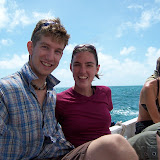
Our group of 12 people was accompanied by 2 amazing guides. To get the most out of our experience we toured about on a sailboat! The water isn’t deep, it’s only between 5 to 30 ft. When the ocean floor is covered with white sand the water appears to be an aqua, blue colour. The coral makes the water dark and mysterious, sometimes it even stuck out. The coral grows as little as 1cm in a year and as much as1 inch, slow and steady. It has a protective gel on it and once touch it becomes susceptible to molds and disease.

We stopped at three spots along the way and had snacks, with lunch in between. They made shrimp ceviche salsa with rum punch for the ride home. Nothing can beat the freshest ingredients. Stop one was at the Coral Gardens with lots of coral and our first spotting of schools of multi coloured fish. I felt like I was in Finding Nemo. Jay and I were a little slow on getting back to the boat, so only I got to see the turtle. It was spectacular to watch it lazily swim about. Stop two was Shark and Ray Alley where we spotted a nurse shark hiding under a coral ledge, along with the red and green parrot fish ( as large as 2 dinner plates ) and a blow fish ( well we think it is called that, or maybe puffer fish.) Stop three was the Hol Chan ( also the name of the reserve) Channel, which is just off the San Pedro island. The channel is created because there is a break in the reef. Boats can get through here. There were many divers practicing for their certification. This was the deepest area of the day. It was a huge contrast to the busy and active reef on either side. We saw a lot! A Green Warrior Moray Eel who would poke his head out from the coral, strutting his under bite and little ‘fangs.’ A sting ray was nestled in the weeds on the ocean floor. His barb was there warning you not to get too close. When he decided to take off it was like he was flying gracefully through the water. A barracuda who was as long and wide as my leg. He had an over-bite and was ugly enough to be a little alarming. Several other larger fish were also trying to hide out close to the bottom of the ocean. All in all, one of the most spectacular experiences we have had on our trip yet!!

Check out some of our pictures here:

Caye Caulker - Belize

Tuesday, February 26, 2008

Tortilla Making

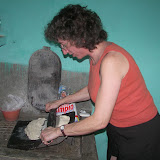
After a girl turns 15 she is eligible to be married (dads live in fear of that day.) Tradition also has it that the woman must be able to make a thin, round corn tortilla. This is a sign that they are able to take up the household responsibilities. You'll often hear the tap tap of tortillas being prepared around meal hours as the women put this time tested art to good use. Some use a press for convienence, but for parties the good old fashioned way is used.
So with Jay's parents in tow we headed over to our adopted family's home to give it a try. Well they say that practice makes perfect, so we all have a lot of work to do!


Following are the basic steps involved in making the tortilla and they are mostly illustrated by our photos.


  1. Water is added to the corn dough (pre-purchsed, but typically made by grinding kernels of corn) and then made to a smooth, sticky consistency by kneading it out with a stone rolling pin on a stone surface.

  2. A small glob of dough (about the size of a pingpong ball) is made into a ball.

  3. The ball is then flatten in your hand, so it is about 1 cm wide.

  4. The dough is placed on a piece of plastic that is about the size of a small dinner plate. This helps to ensure it doesn't stick to the counter.

  5. With the palm of your hand you flatten the tortilla, starting from the center out, while gently spinning the tortilla or the plastic. Ideally you want a thin, circular tortilla.

  6. Place tortilla on pre-heated griddle (ceramic or metal) by peeling the plastic away from the tortilla. Transfer tortilla to your other hand with about half of it resting on your palm only.

  7. Lay it down gently, while removing your hand as the tortilla touches the hot surface.

  8. Monitor your tortilla by how it smells. It is ready to be flipped to the other side when it is lightly cooked. It will be golden coloured.

  9. When ready to flip, gently grasp an up-turned edge with your fingers and switch sides.
  10. Repeat if necessary to ensure both sides are evenly cooked through.

  11. Sprinkle with a little salt if you desire and eat warm.

It is more difficult than it looks. A hard surface is essential. The less handling, the better. Our success rate was not very good!


Tortilla Making

Sights and Sounds of Mexico - A Final Reflection ( Well For Now)


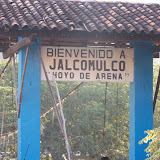
Daily Life In Jalcomulco

"You can't really capture Mexico in photographs or paintings, because they leave out two essentials, smell and sound."


A quote from Piecework by Peter Hamill


As a testimony to the author's conclusion, this blog has been our way of trying to portray those sounds and smells that we have encountered and share them with you. The pictures are the beginning of enhancing your understanding, but the words help to bring your senses to life. I hope that you have enjoyed the stories. Our time in Mexico is quickly drawing to a close as we nervously look forward to moving on. Our first stop will be Belize and from there we will continue through Central America. Our rough time line is to have Central America completed in 2 to 3 months. Our different philosophies about traveling will be tested as we rapidly move through some places and instead spend bigger chunks of time in one place ( at the expense of seeing everything.)


In conclusion to our time here we thought it stewardly to wrap up with some ideas we've pondered and conclusions that we have come to. Some will be funny, while others will be a challenge to you ( as they were for us.) "You can't really capture Mexico in photographs or paintings, because they leave out two essentials, smell and sound."

Time
. Since Jay returned from his trip to Nigeria he has become a slow walker ( much to my dismay sometimes.) Here the pace of life is slow, with much time spent sitting, gathered with friends or family. There are very few cars and instead people walk or take public transportation. With all of this combined (and much less hectic schedules) people are able to "just be" more.
. The siesta is still a major part of life. It takes place mid-afternoon after they've eaten their biggest meal. They've completed the majority of their work and since it is the hottest part of the day, why not take a break. People take a break from their work and put their feet up. Often you'll see our lady land (Dona Rita) lying on the couch watching some TV. They make up for it by working later at nights if necessary. Nights and hang 'n out start at 8 or 9 pm.
. "Ahorita" can mean anything from I'll do what you have asked in five minutes to five months. Meaning when the time is right for them the job will get done.
. If people aren't interested in a social engagement rather than flat out say no they won't be coming they say, which is considered rude, they say yes, even when they mean no.
Church Etiquette
. Pretty much every town has a large church in the down town core. The majority of the churches are Catholic (or some blend of Catholism mixed with native beliefs.) The churches are a focal point. Bellctowers are an important aspect of community living. The bells are rung to communicate with all those living near-by In Jalcomulco if there is a holiday, party or a funeral the bells will toll. It is completely random as to when they will ring, how many times the bell will be rung and for how long it will continue
. As people pass by churches you'll see them "cross" themselves and put their finger to their lips as a sacred kiss. Religion and it's many rituals still have a central role in peoples' lives.

Cuisine
. Fridges are not common here. In fact we have often seen them used as storage, rather than to keep things cold. Maybe it is a power consumption thing or it just could be that they make enough only for a day or two, so there a few left overs. Maybe the fridge is broken. Since they buy food on an as needed basis they don't have to store much in the fridge either.
. Most people have gas stoves, which are fuelled by large propane tanks ( maybe ~ 100lbs.) Once empty you call the propane company, or stop the guys as they drive by, and they switch it for a full one.

. Jay prefers shots of straight cana ( the local moonshine brewed with sugarcane) or tequila to vodka shots.

. Tequila is a much better with either carbonated apple or grapefruit juice.. Lime goes well with most light beers.

. We can handle jalepeno peppers much better now. Biting a seed still makes me sweat though.


Parties
. Quinceniera is probably the biggest celebration in any girls life. It is her 15th birthday, which is a celebration for her coming of age. It rivals a woman's wedding. The girls dress in gowns that are like what a bride would wear but they are any colour. They go all out with flowers and jewllery, in fact families save for years in preparation for this day. Mass is celebrated with friends and family, including 14 guys and girls who are the attendants. They must also be dressed fancy, often in matching colours. The parents share a "this is your life" type reflection. Many pictures are taken before everyone goes to a hall or to the street party where there is dancing, eating and partying that continues all night.
. In Jalcomulco they have a communal wedding day on Valentines. A couple makes their relationship public by leaving the community for a time with out really giving much warning or explanation. Eventually people figure it out. They then start their married life together and wait until the next Valentines Day to make it legal.
. Discos are big. They start at 9:30 and go till 2 am. Here you can hear the music for blocks since it is out on the street.
. Any time there is a celebration fire works are set off. This may happen at any time of day.

Bathrooms
. In public places you often have to pay to use the facilities. Think of it more as a tip to the person who does the cleaning. They may not have toilet paper dispensers, instead they hand you a thick, nicely folded strip of tp.
. Some toilet paper is scented (baby powder or chamoille are common.) It has nice little designs and pictures on it.
. Not all toilets have seats. Good thing it's warm here.
. Only in fancy places or in well to do people's homes are there shower stalls. Everyone else's bathroom is an open concept room. You gotta make sure to try to keep everything dry.
. Water may not come out of a tap. People have cement water reservoirs ( ~ 4' tall and wide and 5' or 6' long), in which the taps are left on for certain parts of the day because that is when there street gets water. It is then pumped up to a black tank on their roof ( but not everyone has one.) There is a local well that people can go to regularly. You can also pay to have some one fill up your tank.
. Occasionally there will be unpleasant smells as you shower. The shower drain is the same pipe as that used for sewage from the toilet. The shower drain has no trap, so the smells waft upward.


Culture
. In order to attempt to create order on the street while people drive, there are brave people who risk their lives by whistling and flagging traffic. They are dressed up very official looking. They stand in the center of streets waving one group of people forward and telling the other to stop. When it is go time, you hear them blow that whistle. Sometimes they are insync with the traffic lights, other times they are not.
. In an attempt to slow people down there is wide spread use of speed bumps or topes (toe pays) at they are called here. They have often been known to appear out of no where and grind the bottom of cars. We've have seen them made of cement, metal (shaped like half a coconut), rubber tires, sand bags, ropes and rocks.

. Though I was worried about geckos at first ( I imagined one scampering on me while I slept) I have come to enjoy them. There are transulscent ones that come out at nights and chirp. Other times you'll hear a little guy scurry in the bush and if you are quick you'll see them go. . Businesses are much more family oriented and run. Kids are much more involved, whether they are 6,16, or 26.. We love the regular emails reminding us that we are missed. Or those telling us about life back home.. Though I was worried about geckos at first ( I imagined one scampering on me while I slept) I have come to enjoy them. There are transulscent ones that come out at nights and chirp. Other times you'll hear a little guy scurry in the bush and if you are quick you'll see them go. . Businesses are much more family oriented and run. Kids are much more involved, whether they are 6,16, or 26.. We love the regular emails reminding us that we are missed. Or those telling us about life back home.

. Though I was worried about geckos at first ( I imagined one scampering on me while I slept) I have come to enjoy them. There are transulscent ones that come out at nights and chirp. Other times you'll hear a little guy scurry in the bush and if you are quick you'll see them go. . Businesses are much more family oriented and run. Kids are much more involved, whether they are 6,16, or 26.. We love the regular emails reminding us that we are missed. Or those telling us about life back home.
. Though I was worried about geckos at first ( I imagined one scampering on me while I slept) I have come to enjoy them. There are transulscent ones that come out at nights and chirp. Other times you'll hear a little guy scurry in the bush and if you are quick you'll see them go.
. Businesses are much more family oriented and run. Kids are much more involved, whether they are 6,16, or 26.
. We love the regular emails reminding us that we are missed. Or those telling us about life back home.

We have learned so much. We hope the pictures and stories impact you in some way.