


Feb 7/ Day One: Getting Started
. Getting to Mexico went smoothly on both parties behalf. Jay was super nervous about the masses of people at the airport but we didn't encounter them till later
. After a stimulating ride from the airport and with the parents getting their first taste of Mexican driving, we checked into our hotel. The Holiday Inn has a marvelous view of the zocalo from the roof top resturant where we dined on the lunch buffet (Mexican time, 2 till 5pm.) We squeaked in just in time at 6pm.
. The rooms are stylish and decadent with huge bathrooms. So many luxuries were enjoyed over the 3 nights that we stayed.
. Prior to settling in for the night we did a walk about to get a sense of the resturants and where would be a good place for breakfast. We also visited the huge Catedral Metropolitana - a massive church that has so many bits and pieces of history attached to it. It's in constant repair due to it's uneven descent into the soft ground. The arcitecture is a combination of styles and designs because it was constructed over so many different eras.
Feb 8/ Day Two: Touring Around the Zocalo
Templo de Mayor
. This crazy, well preserved mess of history is found right in the down town core. These ruins focus mainly on one temple that has had 7 different stages of construction, (1375 to 1502) each stage built on the previous structure making it bigger and hopefully better.
. It's hard to imagine what this place was like when it was first discovered. It makes one wonder why they built a city on an island that was surrounded by a large lake. The vision (an eagle sitting on a cactus eating a snake) the Aztecs saw must have be a powerful incentive to get building a city there.
. Many buildings here proudly bear the effects of earthquakes, time, weather and being built on sand or other sorts of soft ground.
. The museum houses artifacts found on site and enhanced what we saw outside.
. Our first trip to a grocery store where we bought an inhaler for dad (for $4.) It did wonders as the pollution here is horrendous
. We wandered down Madero street which is home to a cool house that's covered by tiles on the outside. (Casa de Azulejos)
. Also discovered a random historical art exhibit at the Palacio de Iturbide ( a government buildings of sorts)
. The Palacio de Bellas Artes is a concert and theatre hall. It has many famous murals and art work that depict parts of Mexico's history
. Park Alameda is named after the poplar trees that line the pathways. It's a breath of nature in the built up city. There are the usual food and souvenir vendors. Jay demonstrated his ability to bargain for his parents. They weres impressed and we return several times to find just the right gifts.
. Most of the evening there were drummers and dancers just across the street from our hotel. It seemed like a random event but the dancers were all insync.
Feb 9/ Day 3: Mexico City Tour
The Plaza of Three Cultures
. This amazing fusion of time and space combines pre-Hispanic culture, Spanish roots and modern dilemas. What you see is the ruins of an ancient Aztec site called s pyrmaid, the Spanish Templo de Santiago and the modern Foreign Affairs Building. The Aztecs were destroyed by the Spanish, who are the forefathers of modern Mexicans.
. The square that borders them was the death bed of many high school protestors in 1968.
. The high rise and apartment buildings that surround the area bear random dates and names that are a momento. They signify the hundreds who died due to collapsed apartment buildings in the 1985 earthquake.
More about the Square
. What started as occasional police intervention between students of 2 rival high schools steadily deteriorated as the police became more and more violent. The students felt oppressed by the police and in an attempt to stop the unjust treatment, they started protesting peacefully. On that fatal day (on the eve of the Mexico City Olympics) the leader realized that something was wrong as the students gathered at the square. He advised the students to leave peacefully. But before everyone could safely leave, government snippers on near by buildings (including the church) were given a go ahead sign by helicopter dropped flares to open fire. The disastorous mess was cleaned up immediately, so no traces were left. It was not mentioned in the morning papers. Despite a monument errected in 1993, the event is not mentioned in Mexican schoolbooks. It makes you wonder what sort of untold details about this exist.
Basilica de Guadalupe
. This is an amazing complex that has 7 different churches all for one saint. The area is massive and millions of very devoted people visit annually. On Dec. 12th(this saint's day,) it was estimated that 12 million people passed through this past year. A whole ritual surrounds this pilgrimage.
. In response to the Spanish impressions of the Virgin Mary it appears a Mexican twist occured. The indigenous people were not to keen on the Catholic influence the Spanish brought until in 1531 Juan Diego saw a vision of a woman who requested he build a church for her. No one believed him until she fulfilled his request for a sign. First there were a bouquet of roses in a specific spot in the desert. The roses tumbled from his cloak as he revealed the sign to the bishop. As he completed this an image of this saint appeared on his cloak. This was all the convincing the bishop needed.
. The original fabric image of "Our Lady of Quadalupe" can be seen at the most recently built basilica (1970) because the other building was too small and beginning to tilt forward. The churches are all built on the grounds where Juan Diego saw the visions. The image is above the main altar and can be viewed from 3 moving walkways. This building has a capacity for over 5000 people and 12 masses can be conducted simultaneously.
The Pulque Distillery
. Our last stop before the ruins was at a Pulque (a cheaper, less potent alcohol than tequila) distillery. They also made all sorts of expensive jewllery from onyx, silver and other precious stones. Mom and I had fun trying some on. It was great to see artisans at work using local, natural products.
. After 7 years of growing the maguey cactus is ready to be harvested. They cut away a few spikes to allow access to the core. Twice a day a large dried out squash with 2 holes in each end is used to suck out the juices. This is done for 2-3 months/plant. The juice is distilled and in the end you are left with a lovely foamy, milky, slightly sour alcohol. The branches ( or whatever you call them on a cactus) have very sharp tips that can be used as needles and the fibers as string. If you peel the fibers away you're left with a thin membrane that can be written on.
Teotihuacan - The Ruins
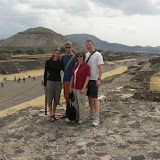
. This is known as one of the first great civilizations in central Mexico. It's largest pyramid is the third largest in the world. It was made of 3 million tons of stone, brick and rubble without the use of metal tools, pack animals or the wheel. The ancient grounds would have covered about 20sq km.
. It is estimated that 125 000 people lived here between 250 to 600 AD.
. The big pyramid is called the Pyramid of the Sun ( with the Moon Pyramid being the second largest on the complex.) It is 70m high, with a base of 200sq m and the total number of steps walked to the top were 248. A little steep at times, but certainly worth it for the view.
. The North South road is known as the "Avenue of the Dead" and lasts about 2km. The Aztecs believe that there are 9 stages of the after world.
. There were several palaces for the royalty, as well as houses for the artisans of the community. The buildings were covered with limestone and painted.
. With the most recent phase of reconstruction (I forget when) the designer felt it important to try to use original materials. There was not enough to be had, so they compromised. Small bits of original volcanic rock can be seen in the mortar between bigger rocks. On most buildings the small pebbles can be seen.
Feb 10/ Day 4: Anthropology Museum
. We were not disappointed to spend several hours in the "best museum in the world" (as Jay's grandparents say.) After we came to understand the lay out and came to grips with how huge it was, we agreed on what our priority items to see should be.
. It is divided into 11 main exhibits ( design by time periods or region.) The lower section has archeological finds, models of tombs, replicas, etc.. and the upper level depicts how modern civilizations now live. We visited the Teotihuacan, Mayan, and Gulf of Mexico exhibits during our 4 hours there.
. We hung out in the park nearby to eat our lunch. We enjoyed hearing about family, friends and life back home.
. Sundays are a great day to brave the metro system because they are not as busy. It cost $0.20 per person! The route system is by colours and each stop has a pictures, so there is no need to be literate to use the metro. Someone was thinking ahead.
. Feb 11/ Day 5: Tour to the Butterflies
 |
| Chronicle of Mom and Dad´s visit to Mexico |


No comments:
Post a Comment