


The Quilota loop has 13 traditional indigenous villages with populations of 1500 to 12 000 people, ranging from 2800m to 3854m in elevation. The scenery was outstanding, made up mostly of a patchwork of fields and forests. Breath taking! Negotiating transportation can be tricky and expensive but we got the perfect idea through a conversation at our hostal.
Isinlivi
We set out by bus along a bumpy dirt road to the town of Isinlivi, where we partyed. The locals were celebrating The Day of the Sun or Saint John´s day. Indigenous people´s beliefs are very much tied to the sun and the moon, along with the changing of seasons. The summer solstice(June 21st) gave them a good reason to party. Some of the festivities we got to see were: the kids raced to the top of a high pole for goodies - even if that meant clambering over top of each other; there was a parade with horses and dead chickens carried on a long wooden pole; the band played and people danced on long into the night; and of course it wouldn´t be complete without a large amount of the local brew. We saw a lot but I can´t say I understand any better what´s behind most of the rituals.
While we were there Jay took part in an ancient indigenous cleansing ceremony. Without going into too many gruesome details, here's more-or-less what happens. The shaman takes a live guinea pig from a burlap sack and spits a crazy alcholol / herbal concoction over it 3 times, then blows smoke over it 3 times. Then, he vigorously rubs the ceremony subject all over with this very same, unfortunate, guinea pig for for between 10 and 25 minutes until it dies. The longer it survives, the longer your life span is believed to be. During the shaking and rubbing, the guinea pig absorbs copies of the person's infermities. Once the guinea pig has expired, the shaman then actually peels it out of its´skin so that he can make a detailed internal examination. Using the guinea pig´s insides the shaman tells you what bodily ailments are present. Jay was thrilled when the shaman told him that he tires easily when he walks, figuring that excuse would come in handy for when he didn't feel like going somewhere! We discovered an interesting catch at the end of the ceremony... our diagnosis ceremony cost $10 (plug $5.25 for the guinea pig) - but the healing ceremony to cure you of the problems diagonsed via the guinea pig cost an exta $15 to be healed... none of the 6 subjects went for the healing.
Highland Hiking: (Isinlivi --> Chugchilan --> Quilotota)
We spent the next two days hiking from one village to another and then up to a volcanic/crater lake. On Monday we went from Isinlivi to Chugchilan, which took us about 5 fantastic hours through some beautiful, remote parts of the country side.
We went without a guide, but a Swiss couplefrom our hostal had hired Jose (a super nice, professional guide and boyfriend of the hostal owner, Kati) to take them on the same hike on the same day. When Jose heard we were going the same way, he said he´d help us so we wouldn't lose our way as we followed behind. The way was fairly clear, but they did call us back from making a couple wrong turns. The most difficult part of the hike was near the end, a 400 or 500m change in elevation completed by a series of switchbacks at about 60 degrees up . We were pretty exhausted after that, but thankfully we didn't have too much farther to go either.
We arrived in early afternoon to Chugchilan, a tiny, middle-of-nowhere town. It boasts a few fantastic hostals. We stayed at the highly recommended ¨Mama Hilda's¨ and were not dissapointed, enjoying one of our favourite rooms of our entire trip. Private bathroom, amazingly hot shower, super cozy double bed, loft, hammock and our favourite part: our own wood stove (even though we're close to the equator, at 3200m above sea level it gets cold)!! We considered just hanging out there for several days, but at supper time a great opportunity presented itself to us for the next day.....
The Swiss couple and Jose were hiking another leg of the trails from Chugchilan to Quilotoa. From there a car would drive back to . They happily invited us to join them. All of our other options involved hiring trucks, staying in Quilotoa ( which we´d been warned had freezing cold accomodations) or catching a 3:00am bus back. None of which sounded appealing! We jump at the opportunity.
So Tuesday morning we left with my pack feeling heavy carrying clothes for both of us. We´d brought along extra things because we weren´t planning on doing that much town to town hiking ( books and stuff.) The previous nights sleep hadn´t been quite enough .
This hike took a bit longer than the previuos day and was alot harder. The scenery was incredible. Though it meant crossing a sketchy bridge and winding our way along a narrow, steep switchback trail up the side of a canyon that had been badly affected by errosion. The sheer, several hundred meter drop on one side and the canyon wall on the other made me glad my mom couldn´t see us then!
I think it was the toughest day of hiking I´ve everd one. We climbed over 1000m, reaching a height of almost 4000m at the edge of the Quilotoa crater. The extra weight of my pack made it extremely tiring, espcecially on the long ascending sections. The thinning air added another dimension. Thankfully our bodies have been well acclimatized. Slow and steady. I made it despite it being exhausting. The view at the end made it all worth while.
The lake of the ( active) Quilotoa crater is absolutely gorgeous. The lake is surrounded by steep 400m rock walls before it plateaus, with the area surronding it rising to rocky out crops and hills or sand plains dipping lower. The cloud pattern at the this of year means that you hike through thick fog to get to the crater edge but the clouds stop exactly at its´crest . It seeems like you´ve hit a wall! Even though we could hardly see 50 m back down our trail, our view out over the lake was totally unimpeded from clouds.
The car that was suppsoed to bring us back had broken down. We ended up on a thin wooden bench in the back of a pick up truck. We were really happy that for the entire 2 hour ride the road was nicely paved. Ange was feeling pretty car sick and I was freezing cold, chilled to the bone and really sore, that just made the hot showers and yummy food at Hostal Tiana even more amazing!
Even though the hiking was not what we had originally intended we were thankful for the great advice, good company and the opportunities. God blessed us with safety, amazing views of one of the most beautiful places in the world. We were reminded that hiking is an intimate way to walk up canyon switch backs, through the network of paths made by indigenous farmers, crossing rivers over sketchy logs and toiling up to the edge of an ancient, active salt water filled volcano crater at 4000m above sea level! WOW!!
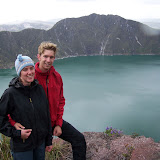 |
| Quilotoa - Ecuadoran Highlands |


No comments:
Post a Comment