


 |
| Huanchaco and their Caballitos |
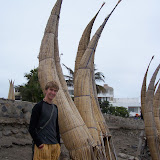
What in the world is that you ask? We spent three days in a beach town just taking it all in. It is very small place renowned for surfing and its handmade old fashioned reed boats. The unchanged nature of these boats is part of what makes them famous. Pottery found 2000 years ago depicts these very same narrow reed boats. The way the boats are "ridden" reminds people saddling up on a horse, with your feet dangling on either side. This is exactly where they got their name from, caballitas de tortora ( little horse).
At first we wanted to go for a ride but when we realized how cold the water was we settled with watching someone else squeal each time a wave splashed her as she got ferried around by a local fisherman. The boats are used to bring out fishing nets and then collected the next morning. Sometimes the men collected crabs or fish off the boat. The boats are wide at the end the fisherman sit in/on and come to a narrow point at the opposite end. Half of a bamboo tree is used as a paddle.
One afternoon I was able to see an elderly gentleman make a boat. Because of the mostly natural materials used, the boats need to be replaced about every 2 to 3 months because they get pretty water logged. The process begins with drying out reeds that are found along the beach. They get laid on the sand until they are dried; a little tough but don´t split. The man had several bundles of them and sorted them according to length, one pile of reeds was 15 ft long and the other 10ft. Each of the two piles were split fistful by fistful into two. At this point we have four piles of two different lengths of reeds.
Now he works on one pile at a time but does the identical thing to each of the four piles. To make each part bouyant and a cluster of foam is inserted at the end of the reeds. He basically rams the package of foam in and wraps the reeds around them so the foam is in the middle. To ensure it doesn´t come apart he secures the length of the reeds in three spots using another piece of reed. Once he is satisfied, it is re-inforced with fine rope starting at the fat end, going until the point, wrapping it all securely as he goes.
Now that all four pieces are formed he has to join them together. The shorter lengths are squeezed into the longer lengths, in a similar manner as the foam. He secures everything in place with rope. Then the two longer pieces are joined together using rope. The final pushing and pulling is done with two people as it is secured very tightly.
The manner with which this man carried out his work was one of well practiced knowledge. At one point I watched as he measured a reed from his feet to his nipple line. His makeshift but relaiable measurements would ensure that the length of his boat where he stored his fish or would sit in was just the right size for him. His well worn hands were weathered with many years of practice.
It was a really unique experience to be able to observe such an ancient tradition still being such a part of the regular daily life of this town. Thinking that the fish we ate for dinner was caught by a man in a little reed boat of 2000 year old design really puts the saying 'passed down from generation to generation' in a new perspective for us!


No comments:
Post a Comment